
Why High-Performance 3D Printing Filaments Matter
For engineers, designers, and manufacturers working in demanding industries—such as aerospace, automotive, oil & gas, and healthcare—standard 3D printing materials like PLA or PETG are often not up to the task. When you’re dealing with extreme temperatures, mechanical loads, flame retardancy, or aggressive chemicals, you need something more robust.
This is where high-performance filaments come in. These advanced materials are engineered to deliver mechanical strength, thermal stability, and chemical resistance in the most challenging environments.
At Filamentive, we offer an optimised range of industrial-grade filaments—PEEK, PEEK-CF, and Ultem™ (PEI)—designed for mission-critical applications.
What Are High-Performance 3D Printing Filaments?
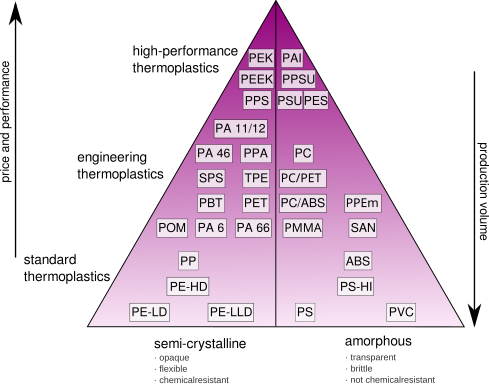
High-performance filaments are a class of engineering-grade thermoplastics with exceptional mechanical and thermal properties. Key attributes include:
- Continuous-use temperatures exceeding 150°C
- Flame retardancy to UL 94 V-0
- Broad chemical resistance to solvents, oils, and fuels
- High tensile and compressive strength
- Dimensional stability over time, temperature, and load
Common high-performance materials include PEEK, PEKK, PPSU, Ultem (PEI), and their reinforced variants.
For a full comparison, see our guide: PEEK vs PEKK vs PPSU vs Ultem (PEI)
Ultem vs PEEK Filament: A Technical Material Comparison
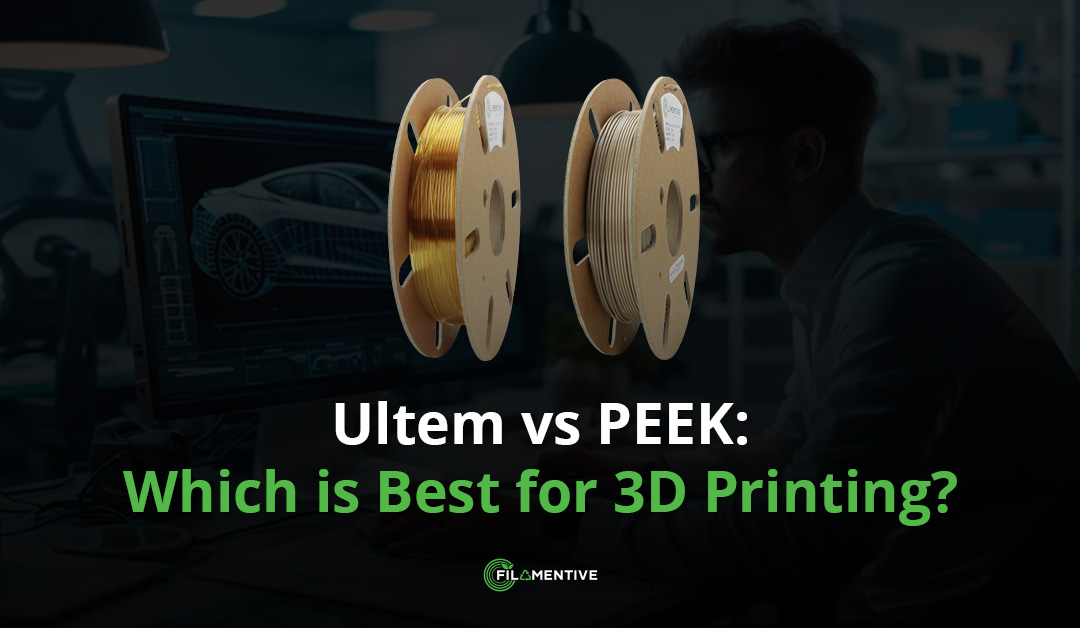
Two of the most widely used high-performance 3D printing materials are PEEK (Polyether Ether Ketone) and Ultem™ (Polyether Imide/PEI). Both deliver outstanding performance, but their properties—and ideal use cases—differ.
One of the most important technical distinctions is the morphological structure:
- PEEK is semi-crystalline, containing both ordered crystalline and amorphous regions.
- Ultem (PEI) is amorphous, with a completely disordered molecular structure.
Why does this matter?
- PEEK’s crystalline regions offer superior dimensional stability and mechanical retention at high temperatures—making it ideal for sustained mechanical loads above 250°C.
- Ultem’s amorphous nature allows for predictable shrinkage, easier post-processing, and better layer adhesion, particularly important in aerospace interiors and tooling.
This distinction influences performance above the glass transition temperature (Tg)—and helps determine which material best fits your application.
Choosing the Right Material: PEEK vs PEEK-CF
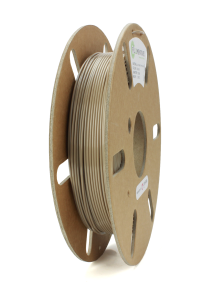
PEEK Filament
PEEK is the benchmark for strength, temperature resistance, and chemical durability. With a continuous-use temperature above 250°C, it’s trusted in sectors where metal replacement, lightweighting, and thermal stability are essential.
- High strength-to-weight ratio
- Excellent resistance to wear, fatigue, and chemicals
- Semi-crystalline for outstanding dimensional accuracy
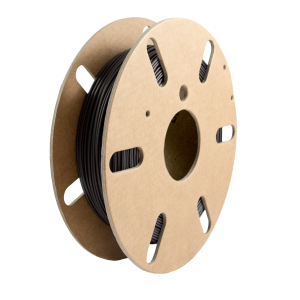
PEEK-CF Filament
PEEK-CF is reinforced with 15% chopped carbon fibre, making it stiffer, stronger, and more resistant to deformation.
- Higher HDT: up to 280°C
- Reduced warping and shrinkage
- Ideal for structural and load-bearing components
Choosing the Right Material: Ultem 9085 vs Ultem 1010
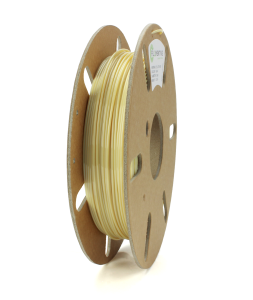
Ultem™ 9085 Filament
Ultem™ 9085 is a flame-retardant, FST-rated PEI filament trusted across aerospace, rail, and automotive sectors. It’s easy to process and holds multiple certifications (FAR25.853, EN45545).
- Excellent strength-to-weight ratio
- Predictable shrinkage and high dimensional stability
- Easy post-processing and machining
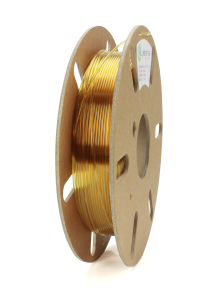
Ultem™ 1010 Filament
Ultem™ 1010 offers an even higher glass transition temperature (217°C), making it suitable for demanding applications in moulds, jigs, and medical tooling.
- Higher rigidity and thermal resistance than 9085
- Suitable for sterilisation and tooling
- Easy to print for its class
What the 3D Print Industry Thinks: LinkedIn Poll Insights
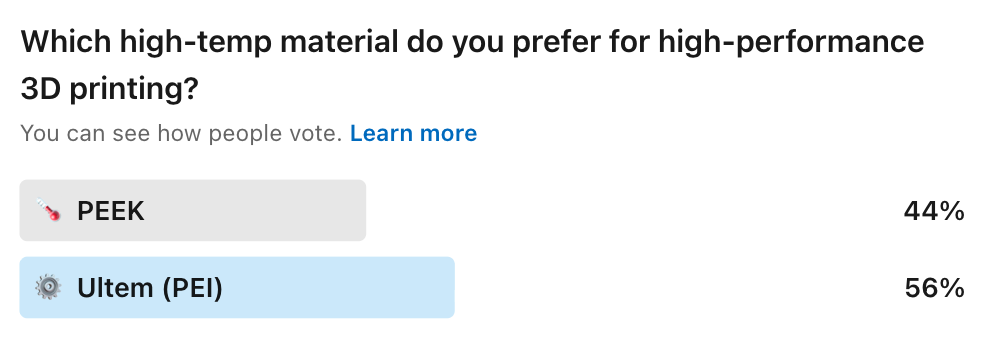
In a recent LinkedIn poll, we asked professional 3D printing users which high-temp material they prefer for their high-performance 3D printing applications:
One respondent shared:
“Personally, I prefer ULTEM; it’s a bit simpler to print (especially related to bed adhesion and first layers), it’s a bit less demanding on printers, and it’s a bit cheaper than PEEK. And the performance is actually quite similar.”
This highlights a key trend: Ultem is often preferred for its practicality and accessibility, while PEEK remains the top choice for extreme conditions.
Ultem vs PEEK: 3D Print Material Technical Comparison Table
| Property | PEEK | PEEK-CF | Ultem 9085 | Ultem 1010 |
| Structure | Semi-crystalline | Semi-crystalline + CF | Amorphous | Amorphous |
| Continuous Temp (approx.) | 250°C | 280°C | 170°C | 217°C |
| Flame Retardant (UL94 V-0) | Yes | Yes | Yes | Yes |
| Mechanical Strength | Excellent | Maximum (rigid) | Very Good | Excellent |
| Ease of Printing | Challenging | Challenging | Easier | Easier |
| Certified Use Cases | Aerospace, Medical, Auto | Automotive, Aerospace | Aerospace, Rail | Medical, Tooling |
| Price | High | Very High | Moderate | Moderate |
High Performance Material Matrix: Is PEEK or Ultem Best? [Table]
| If you need… | Choose… |
| Maximum heat and chemical resistance | PEEK / PEEK-CF |
| Structural stiffness and minimum warping | PEEK-CF |
| Certified aerospace or rail interiors | Ultem 9085 |
| High-temperature tooling or medical use | Ultem 1010 |
| Easier 3D printing with consistent results | Ultem |
| The best performance regardless of cost | PEEK |
Why Filamentive PRO for High-Performance 3D Printing?
Filamentive PRO is your source for UK-stocked, professionally tested, high-performance 3D printing materials.
✅ Materials available:
✅ Why choose us:
- UK stock + next-day delivery
- Moisture-controlled, vacuum-sealed spools
- 100% recyclable packaging
- Backed by application support