
3D printing is efficient, flexible and increasingly embedded in education, engineering and manufacturing across the UK. But it is not waste-free. Failed prints, support structures, purge towers, calibration models and spool ends quietly accumulate. Even in well-run environments, a meaningful proportion of printed material never becomes a finished part. Industry estimates suggest that up to a third of printed material can end up as waste once supports and failed iterations are accounted for.
The sustainability conversation in additive manufacturing often focuses on material choice — recycled content, bio-based polymers, lower carbon supply chains. Yet for many operators, the more immediate question is simpler: what do we actually do with the waste we generate?
This guide sets out the reality in the UK today. It explains why kerbside recycling rarely works for 3D printing waste, and it examines the two practical routes available: in-house DIY recycling and specialist recycling schemes.
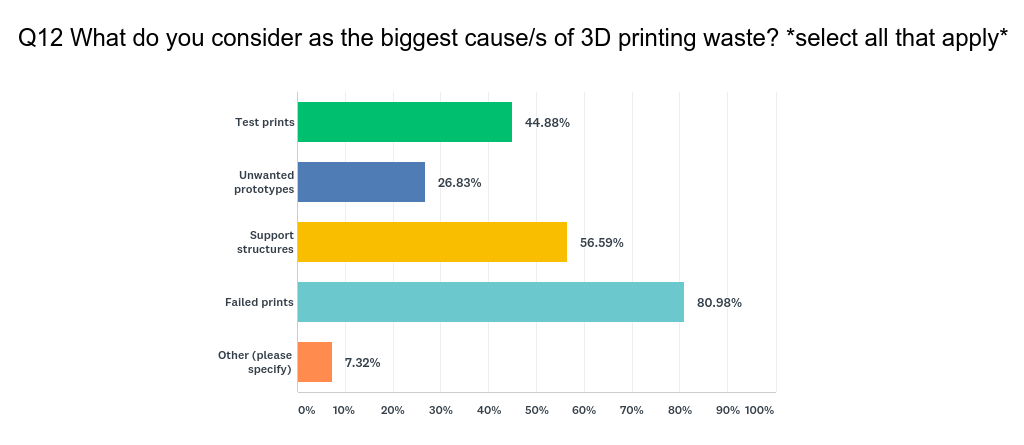
What are the Main Contributors to 3D Printing Waste?
Caption: Source: https://www.filamentive.com/the-3d-printing-waste-problem/ (2019)
In FFF/FDM environments, waste typically includes failed prints, support material, purge lines from colour changes, brims and rafts or test pieces. These materials are often small, rigid and polymer-specific. They are not the same as drinks bottles or household packaging, and that distinction matters when we talk about recycling infrastructure.
Understanding your waste stream is the first step toward managing it responsibly. PLA behaves differently to PETG. Nylon behaves differently again. Mixed polymers introduce contamination risks that can render recycling unviable.
Can You Recycle 3D Printing Waste Kerbside in the UK?
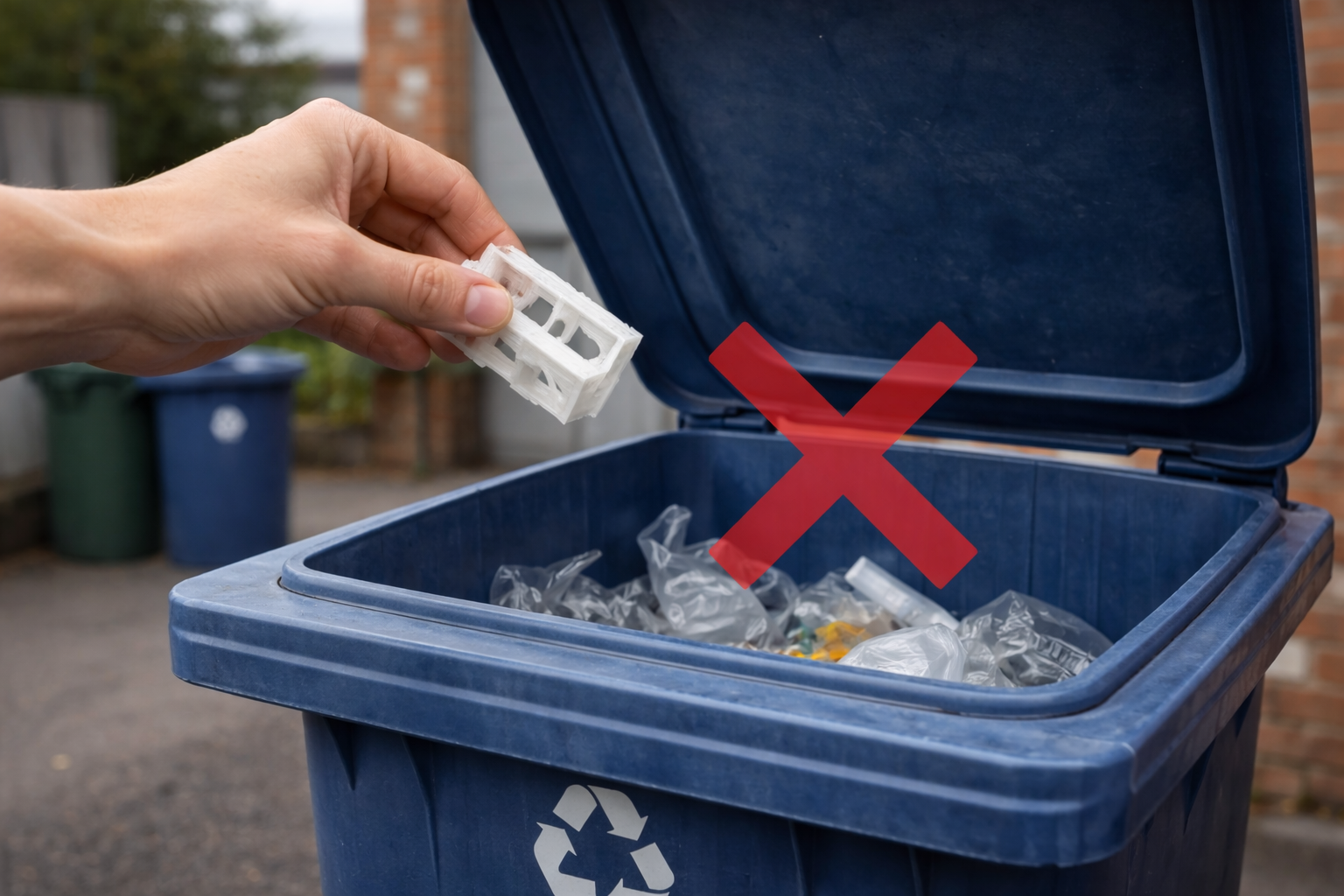
Technically, some 3D printing polymers are recyclable. Practically, access to appropriate infrastructure is limited.
Take PLA as an example. PLA is often described as biodegradable, which is true under controlled conditions. However, most UK local authority kerbside recycling systems do not accept PLA from 3D printing. Sorting facilities are designed around common packaging plastics such as PET and HDPE. PLA is difficult to distinguish visually, and when mixed into PET streams it can contaminate recycling batches. It is also not compostable in home compost or in landfill conditions. As a result, most PLA waste placed in household recycling bins is unlikely to be processed as intended.
PETG presents a similar challenge. Although chemically related to PET, it is not treated the same way in municipal systems. Small volumes of rigid PETG parts from 3D printing are not typically accepted via kerbside routes. ABS and ASA can be mechanically recycled, but again, not through standard household collection. Nylon, including PA12 and PA6, has value in industrial contexts, yet small-scale desktop printing waste rarely has a straightforward public recycling route.
In short, for most operators in the UK, placing 3D printing waste into a recycling bin is not a viable options.
Should you turn 3D Printing Waste into Filament in-house?
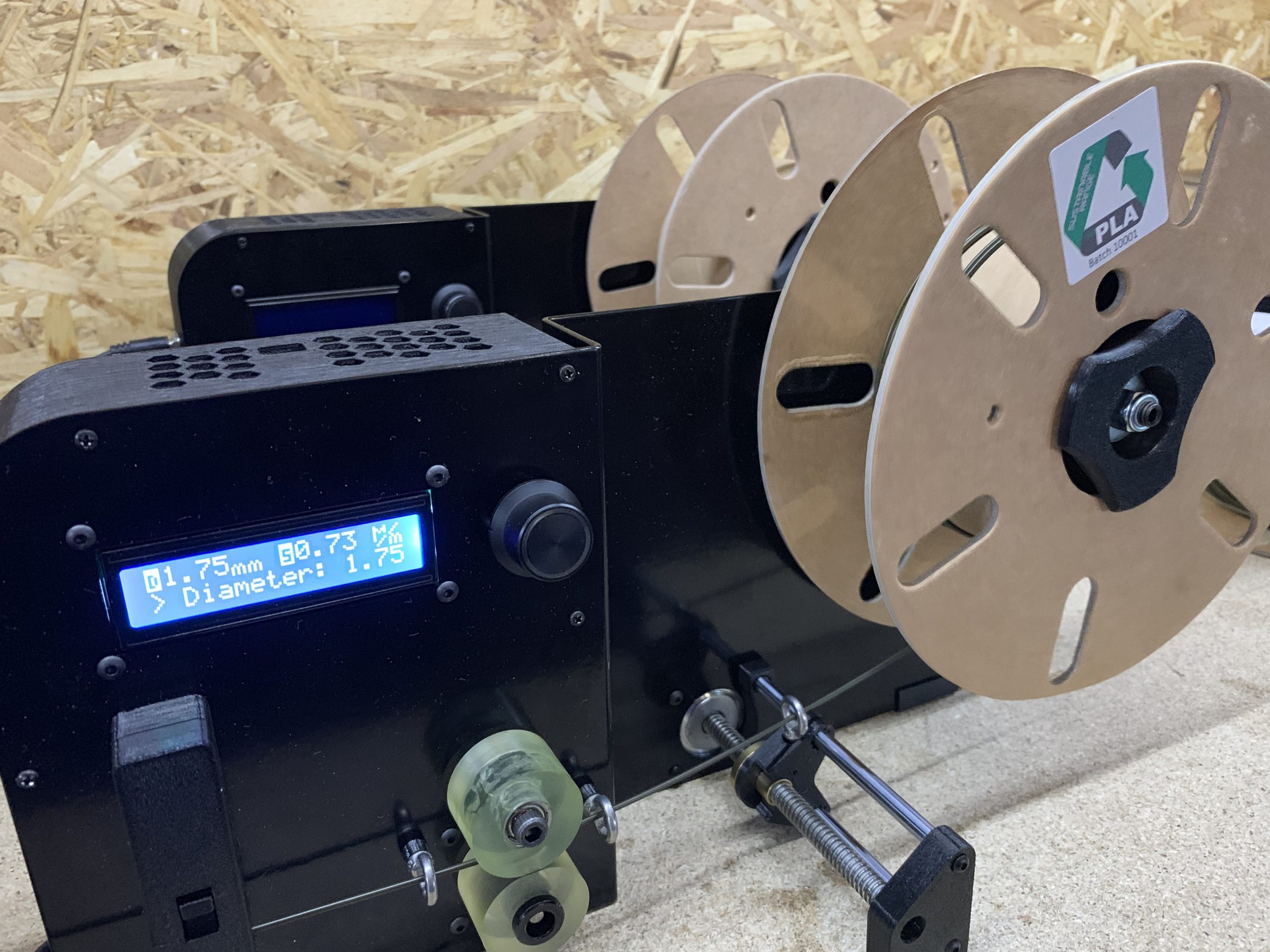
The idea of in-house recycling is compelling. Collect failed prints, grind them down, dry them thoroughly, extrude a new filament strand, spool it, and print again. In theory, you close the loop within your own workshop. In practice, it is less straightforward.
A reliable setup requires a plastic shredder or granulator, a drying system capable of removing moisture consistently, a filament extruder, and a winder or pelletiser. These machines represent a significant capital investment, often running into thousands of pounds. They also require space, electrical capacity, safety measures and trained operators.
The process itself demands discipline. Waste must be segregated by polymer type and often by colour. Moisture must be removed thoroughly, particularly for hygroscopic materials such as PLA and nylon. During extrusion, temperature control and screw speed must be carefully managed. The resulting filament must be monitored for diameter consistency, as even small variations can cause print failures.
PLA can be unforgiving. Slight moisture content or contamination can lead to brittle parts, poor layer adhesion or surface defects. Multi-cycled scrap may require blending with virgin material to stabilise properties.
DIY recycling is possible. For research laboratories and technically curious operators, it can be a valuable exercise in circular material science. But for busy production environments, universities and commercial print farms, the return on investment often looks different once staff time, maintenance, energy consumption and downtime risk are factored in.
Learn more: A Practical Guide to Recycling 3D Print Waste into Filament.
Cost Guide: Is DIY 3D Printing Filament Making Worth It?
Before investing in equipment, a proper cost–benefit analysis is essential. Consider:
- Total cost of ownership for shredder, dryer and extruder
- Staff time for setup, training and quality assurance
- Ongoing maintenance and energy use
- Risk of inconsistent filament affecting production
- Current annual spend on filament
For some teams, the capability and learning curve are worthwhile. For many others, especially where uptime and consistency matter, DIY recycling of 3D print waste into recycled filament introduces more variables than it removes.
Is there a Specialist Recycling Scheme for 3D Print Waste?

Recognising that most operators do not want to become polymer processors, specialist 3D print waste recycling schemes provide a structured pathway for waste recovery without requiring in-house machinery or the necessary time & labour resources.
In the UK, Filamentive operates a free PLA recycling scheme designed for higher-volume users. Delivered in partnership with a specialist recycler, 3D Printing Waste, the model is straightforward: collect clean PLA waste such as failed prints and supports in a supplied box, and arrange collection for processing under controlled conditions.
There is no requirement to shred, dry or extrude the material yourself. Waste is diverted from landfill and processed through established waste management channels for hassle-free recycling.
It’s also worth noting that, in the UK, ReFactory also offers a 3D Printing & Filament Recycling Box.
DIY Filament vs Specialist Recycling: Which Is Better?
| DIY Recycling | Filamentive Solution | |
| Additional Cost | Thousands of pounds for shredder, dryer, extruder | Zero – we supply the box and handle recycling once min. spend achieved. |
| Time & Skills | High skill. Trial and error; risk of contamination and failure | None. Simply fill the supplied recycling box and we’ll pick it up |
| Result | 100% recycled filament in theory; variable quality and virgin material likely needed after multiple cycles | 100% free PLA waste recycling + supply of PLA and PETg made from high percentage recycled material |
Choosing between DIY recycling and a specialist scheme depends on context.
DIY recycling may suit you if you have budget, space, technical expertise and time to experiment. It can deliver insight into polymer behaviour and demonstrate circular principles within a lab setting.
A specialist recycling scheme is often better suited to print farms, engineering teams and educational institutions that prioritise 100% landfill diversiob and minimal disruption. It removes capital expenditure, reduces process risk and provides a clearer sustainability narrative.
In most commercial environments, separating printing operations from recycling operations is the more practical and scalable decision.
Closing the Loop for 3D Printing Waste Recycling in the UK

The reality in 2026 is that most 3D printing waste in the UK does not have an easy kerbside route. Operators who care about reducing environmental impact must look beyond the household bin. Whether that means investing in in-house recycling capability or partnering with a specialist scheme, the important step is moving from intention to action.
Circular 3D printing in the UK is achievable — but it requires practical systems, not assumptions, to make it work.