

PETg sits in a useful middle ground: tougher and more impact resistant than PLA, but still straightforward enough for everyday printing without moving into specialist engineering polymers. It’s the material most people reach for once a printed part needs to actually work, not just look good.
What’s changed by 2026 is less about the material itself and more about format. For UK buyers, choosing PETg increasingly means choosing the right version of PETg for your printer and workflow — not just picking a spool off a shelf. Filamentive now supports that decision directly, with standard PETg filament, Bambu Lab-ready ReFill PETg, XL PETg for high-volume printing, and Carbon Fibre PETg for engineering applications.
This guide walks through what PETg is, when to use it over PLA, and which of these four formats actually fits your setup.
What Is PETg Filament? Why Is It So Widely Used in the UK?
PETg is PET — the same polymer family as most plastic drink bottles — modified with glycol to make it easier to 3D print.
PETg filament is best used for functional 3D-printed parts that need more toughness and impact resistance than PLA offers — brackets, enclosures, jigs, prototypes and mechanical components. It combines good layer adhesion with low warping, making it a reliable middle ground between easy-to-print PLA and specialist engineering polymers.
PETg vs PLA 3D Printing Filament: When Should You Use PETg?
PLA is the easier starting point — rigid, good surface finish, forgiving to print, and fine for models, display pieces and general-purpose prints.
PETg is the step up when a part needs to work under some kind of load or stress. It’s tougher, more impact resistant, and holds up better to moderate heat than PLA. If a print keeps snapping, cracking on impact, or warping in a warm car boot, PETg is usually the fix.
Which UK Stocked PETg 3D Printer Filament Should You Choose?
| PETg Type | Best For | Key Benefit |
| Standard PETg | General functional printing | Tough, versatile |
| ReFill PETg | Bambu Lab AMS users | Reusable spool format |
| XL PETg | Production / print farms | Fewer spool changes |
| CF-PETg | Engineering parts | Higher stiffness |
Filamentive’s PETg range isn’t one product — it’s four, each built around a different way of printing.
Standard PETg – Best for Everyday Functional Printing
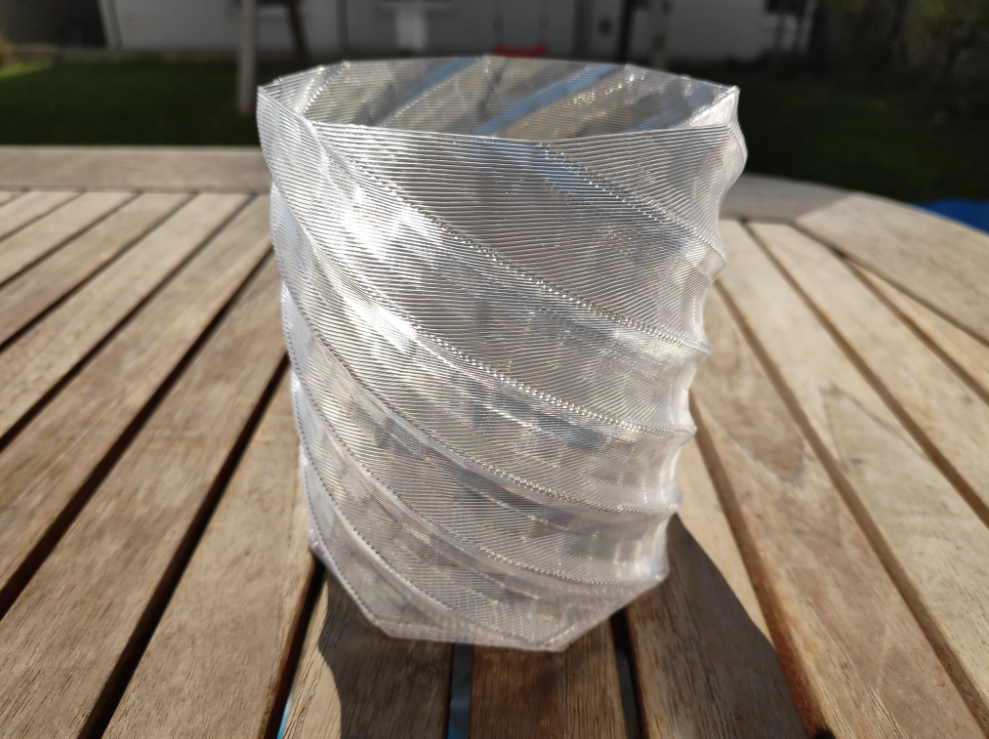
This is the all-rounder: 100% recycled PETg polymer by weight, sourced from post-industrial material and verified through Filamentive’s ISO 14021 recycled-content declaration. It offers strong layer adhesion, good impact resistance and low warping, with a low odour during printing — suited to prototypes, housings, brackets, enclosures and general functional parts.
It’s available in both 1.75mm and 2.85mm, across a broad colour range, with UK stock as standard. Typical settings are around 240±15°C nozzle and 70–80°C bed, though we’d always recommend checking the specific product page for your colour and batch.
Spool-less ReFill PETg – Best for Bambu Lab AMS Users
Bambu Lab’s reusable spool system has changed how a lot of users think about filament packaging. ReFill PETg is Filamentive‘s response: the same recycled PETg material, supplied spool-less to fit Bambu Lab’s reusable spool rather than a single-use one.
For AMS workflows in particular — where multiple spools are loaded and swapped regularly — ReFill cuts down on unnecessary spool material without changing the print profile you’re already using. It’s aimed at Bambu Lab operators running multi-material setups or simply printing at higher volume.
Filamentive is not affiliated with or endorsed by Bambu Lab, Inc.
XL PETg – Best for Long Runs and High-Volume Printing
XL PETg isn’t just a bigger spool — it’s a different way of managing a print queue. Available in larger formats (from 2.3kg up to 8.5kg depending on the variant), it’s built for setups where frequent spool changes are the actual bottleneck: print farms, universities, service bureaus, and anyone running long or repetitive production jobs.
Fewer spool swaps means less downtime and less risk of a failed print because nobody caught an empty spool overnight. As a rough guide: if you’re getting through multiple 1kg spools a week, XL is worth the switch. Note that XL spools need an appropriate external spool holder or feed setup — they won’t generally fit inside an enclosed AMS system.
Carbon Fibre PETg – Best for Engineering and Industrial Parts
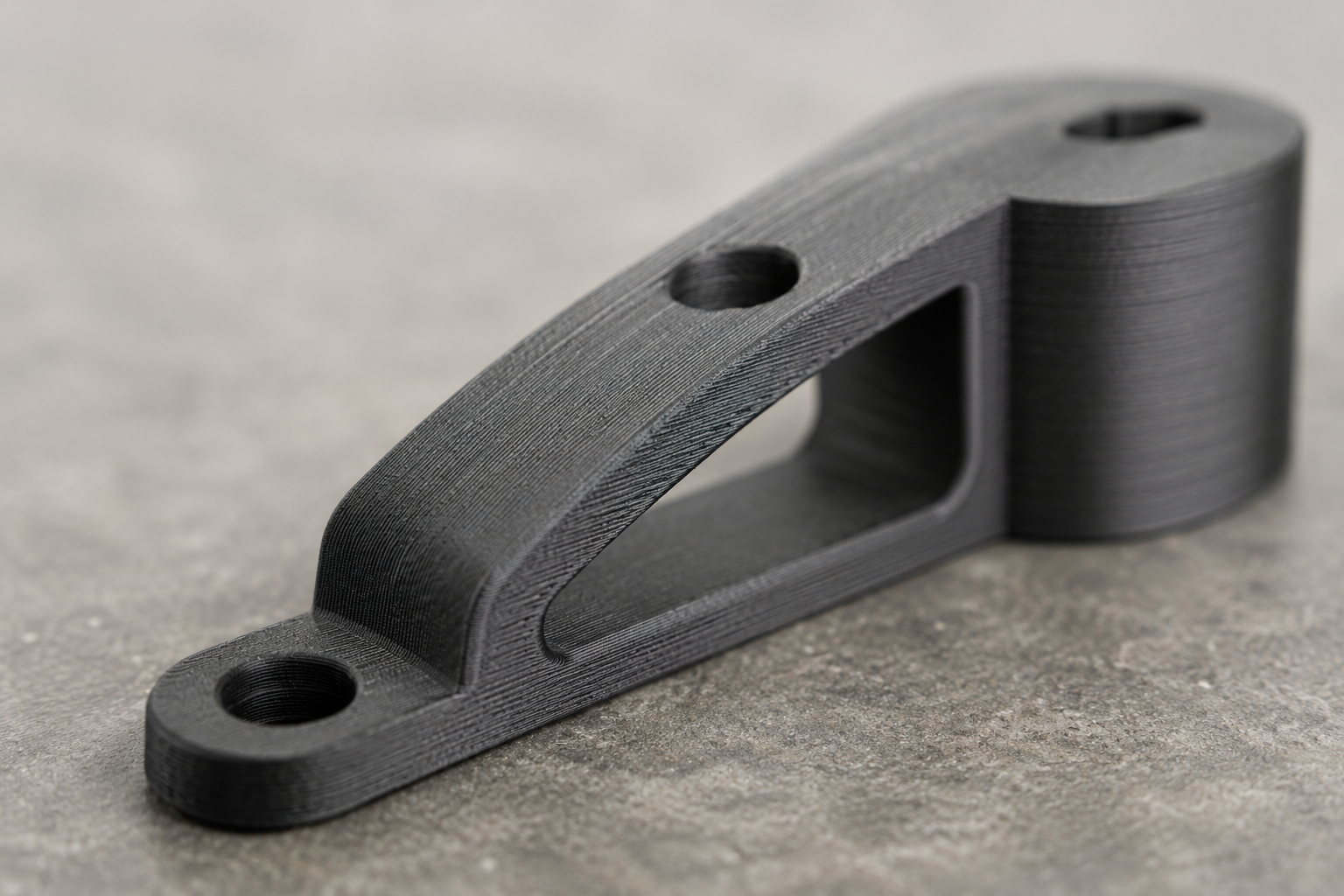
Filamentive’s Carbon Fibre PETg blends 85% recycled PETg with 15% recycled carbon fibre powder, giving it meaningfully higher stiffness, better dimensional stability and a matte technical finish compared with standard PETg.
It’s the right choice when a part needs to hold its shape under load rather than flex — jigs and fixtures, tooling aids, drone components, automotive prototypes, and other mechanically loaded brackets and parts. The trade-off is that carbon fibre is abrasive, so a hardened steel (or similarly wear-resistant) nozzle is recommended rather than a standard brass one.
Can You Use PETg with Bambu Lab Printers and AMS?
Yes. Filamentive’s standard 1.75mm PETg works with Bambu Lab printers and AMS using the equivalent PETg profile in Bambu Studio, the same as it would with any compatible slicer. For AMS users specifically, ReFill PETg is the more optimised format, since it’s designed to sit directly on the reusable spool rather than adding another single-use one into rotation. Standard spooled PETg remains a perfectly valid option too — ReFill is about reducing packaging, not a requirement for compatibility.
Is Recycled PETg Filament as Good as Virgin PETg?
This is the objection worth addressing directly, because “recycled” doesn’t automatically mean “compromised.” Performance depends on how the material is actually handled: feedstock consistency, contamination control, drying, extrusion consistency and diameter tolerance all matter more than whether the base polymer started life as virgin or recycled resin.
Filamentive’s PETg uses 100% recycled post-industrial PETg with traceable production and quality checks at each batch. The short version: recycled content is a sourcing decision, not a performance ceiling — the manufacturing discipline behind it is what determines reliability.
When Should You Use Carbon Fibre PETg Instead?
Standard PETg is the better choice when some flexibility or impact absorption is actually useful — most everyday functional parts fall into this category. Reach for Carbon Fibre PETg instead when rigidity and dimensional stability matter more than flex, when a part is under real mechanical load, or when you specifically want the matte technical finish. It’s not a universal upgrade — it’s the right tool for a narrower set of jobs.
PETg Filament in 1.75mm vs 2.85mm
1.75mm dominates most current desktop and Bambu Lab-style printers, and it’s where the bulk of new demand sits. But 2.85mm filament hasn’t disappeared — it remains relevant to legacy and professional systems, including certain UltiMaker machines still in active use across UK workshops and universities. Filamentive continues to support both diameters across its PETg range, so switching printers doesn’t necessarily mean switching supplier.
Why Buy PETg 3D Printing Filament from a UK Supplier?
UK stock means shorter lead times and none of the customs uncertainty that comes with importing filament directly. It also makes technical support genuinely usable — a real conversation during UK hours rather than a support ticket sitting overnight. For businesses and institutions, buying UK means easier purchase orders, bulk pricing conversations, and access to the sustainability documentation — recycled content declarations and material data — that procurement teams increasingly need to sign off a purchase. The result is a more predictable procurement process from enquiry to delivery.
Whether you need a single 1kg spool for prototyping, AMS-ready ReFill PETg for Bambu Lab, XL spools for continuous production, or Carbon Fibre PETg for engineering parts, Filamentive supplies PETg formats built around real 3D printing workflows rather than a one-size-fits-all spool.
Which UK PETg 3D Printing Filament Is Right for You?
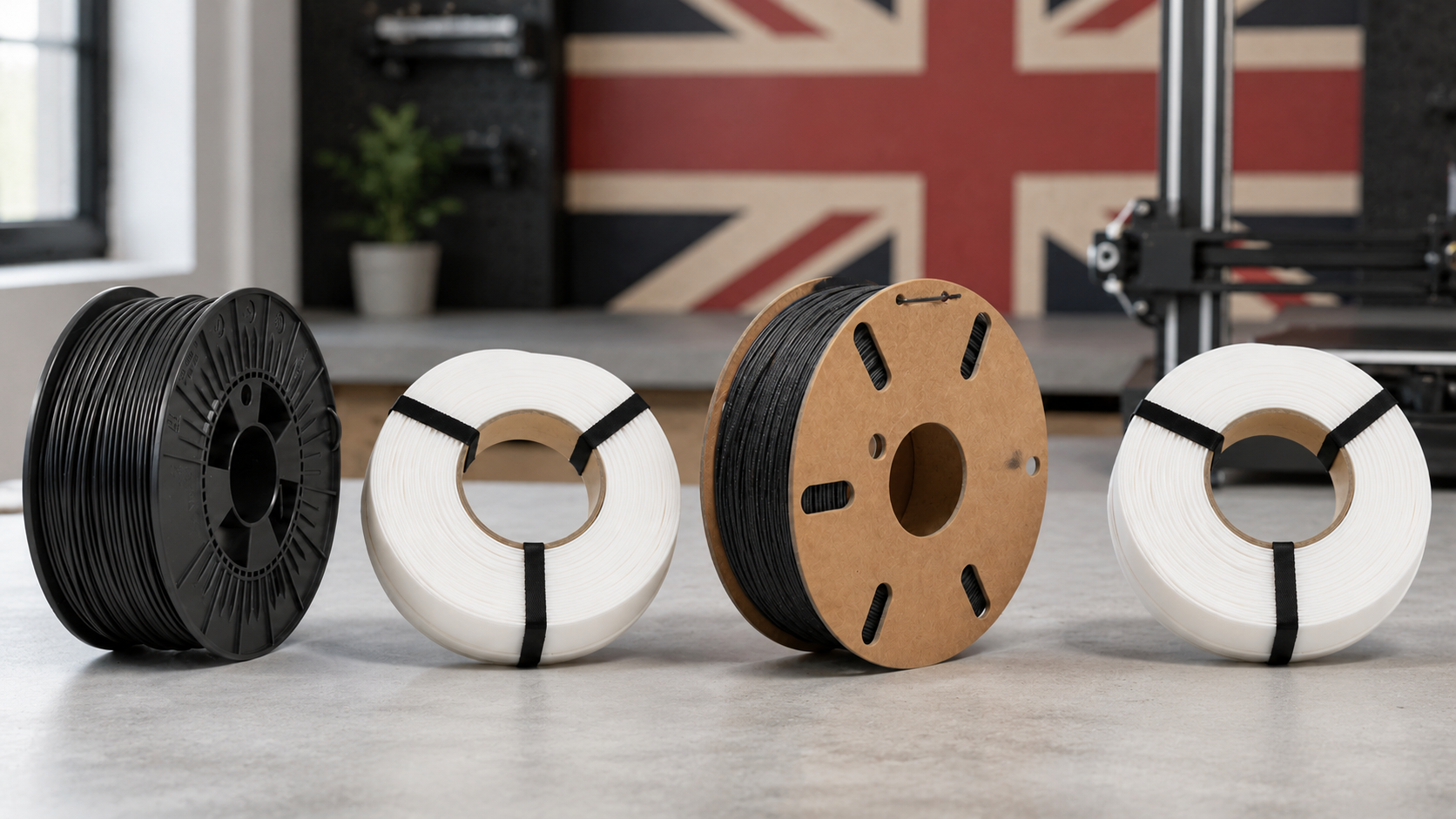
Choose standard PETg for versatile, everyday functional printing.
Choose ReFill PETg if you’re running Bambu Lab reusable spools or AMS workflows and want to cut down on spool waste.
Choose XL PETg if you print continuously or consume filament at scale.
Choose Carbon Fibre PETg if stiffness, dimensional stability and engineering performance are the priority.
Explore Filamentive’s full PETg range in UK stock, or get in touch with the team for bulk, technical or material-selection support.