
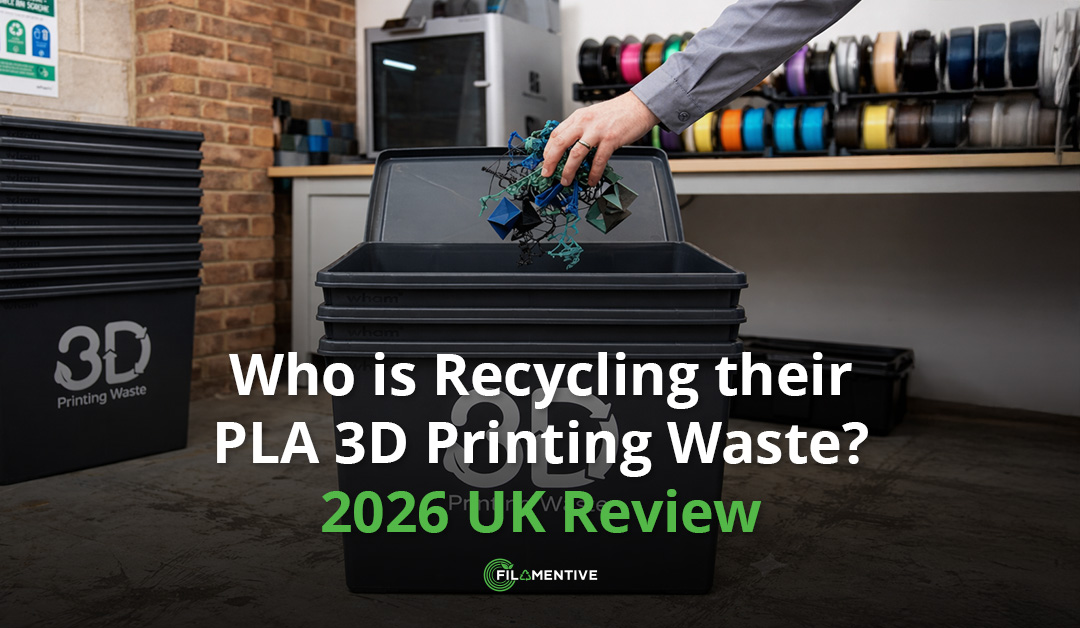
When we launched the UK’s first free PLA 3D printing waste recycling scheme in April 2024, our initial goal was straightforward: recycle one tonne of PLA waste within 12 months. Two years on, we’ve now diverted 2.5 tonnes of PLA 3D printing waste from landfill — and the organisations making that happen tell a story about where sustainable 3D printing is really taking root across the UK.
Our PLA recycling scheme, run in partnership with specialist recycler 3D Printing Waste (3DPW), gives Filamentive customers a free, practical route to responsibly dispose of failed prints, support structures, reel ends and filament offcuts. Since April 2024, 50 unique customers have taken part — from university maker spaces and manufacturing firms to architectural model-makers and professional 3D printing bureaus.
This review looks at who those customers are, how recycling behaviour is changing, and what the data tells us about the direction of travel for responsible 3D printing in the UK.
Why PLA 3D Print Waste is not Biodegradable in UK Landfill
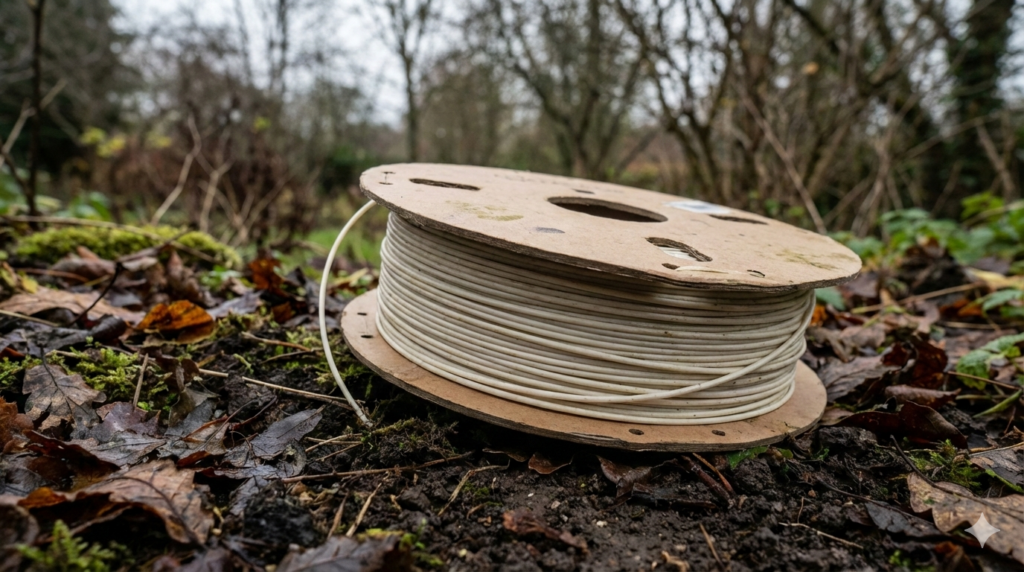
PLA is the most widely used 3D printing filament in the UK, and it’s frequently marketed on the basis of its bio-based origins. But biodegradability in standard conditions is routinely overstated. PLA requires industrial composting infrastructure to break down effectively — infrastructure that most UK waste streams simply don’t provide. Without a dedicated collection route, even the most environmentally conscious operators can unintentionally send their print waste to landfill.
This is the problem the scheme was designed to solve. Filamentive’s own research found that prior to the scheme, around 89% of PLA waste was going unrecycled — not through indifference, but through a lack of accessible, affordable options.
Cost and logistics were the two primary barriers. By removing both, and linking recycling access to existing filament spend, the scheme has enabled organisations across multiple sectors to close a material loop that was previously left open.
PLA 3D Print Waste Recycling Scheme Growth: 2025/26 Results
Participation across the scheme grew by nearly 18% year-on-year, and the number of organisations actively returning waste rose by close to 9%. On their own, those figures would be a solid result for any voluntary industry initiative. What makes them more meaningful is what’s happening to engagement depth.
The average number of returns per participating organisation increased by around 9% compared to the prior year. That’s not a trivial number. It’s the difference between organisations trying a recycling scheme once and organisations that have embedded returns into their regular operations. The scheme is becoming part of how people run their businesses — not an add-on, not an annual gesture, but a recurring workflow.
A significant share of this year’s participants were entirely new to the scheme. New entrants came from across the spectrum of Filamentive’s customer base, spanning universities, manufacturers, design studios and 3D printing service bureaus. The breadth of new joiners suggests that awareness of the scheme is spreading through professional networks and sector communities — which is exactly how sustainable practice tends to propagate most effectively.
Why Universities Are Leading PLA Recycling in the UK
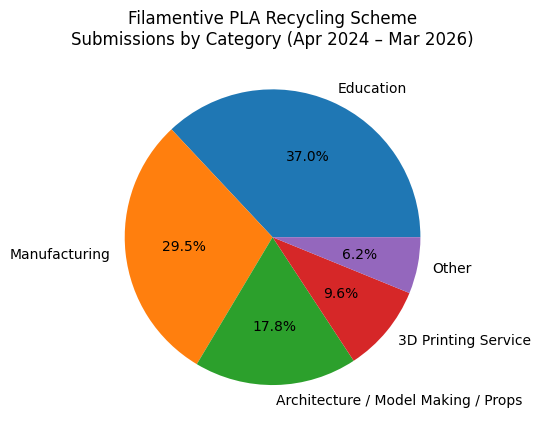
The single clearest story in this year’s data is the role of the education sector. Universities and higher education institutions now account for over 40% of all recycling activity through the scheme — up from around a third the previous year — representing a 45% increase in engagement year-on-year.
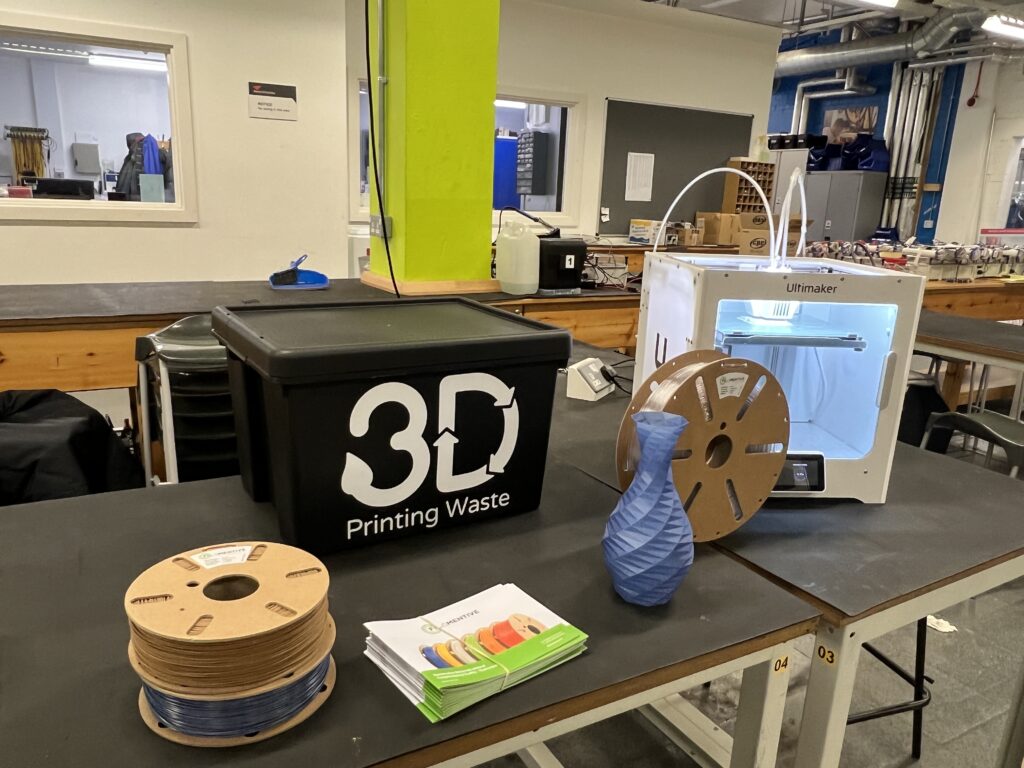
This reflects a structural reality: university makerspaces and fabrication labs run 3D printers at high volume, generating sustained streams of PLA waste from student projects, prototyping, research and teaching. That volume creates both the need and the justification for a structured approach to end-of-life (EoL) 3D printing material management.
What’s changed is the organisational priority being placed on acting on that need. Institutions across the UK — including leading Russell Group universities, specialist arts colleges and dedicated 3D printing facilities — are now making repeated, consistent use of the scheme. For many, recycling has moved from an occasional initiative to an embedded operational practice.
The cultural dimension is equally significant. Sustainability credentials are under greater scrutiny from students, staff, institutional funders and accreditation bodies. A free, documented, third-party-verified PLA return scheme provides a practical and visible expression of commitment — one that requires minimal operational overhead to maintain.
It’s also worth noting the longer-term signal that university engagement sends. The engineers, designers and product developers going through these makerspaces today will carry their material habits into industry. Normalising responsible waste management at the educational stage has compounding value that extends well beyond the university gates.
How Manufacturers Are Recycling 3D Printing Waste in the UK
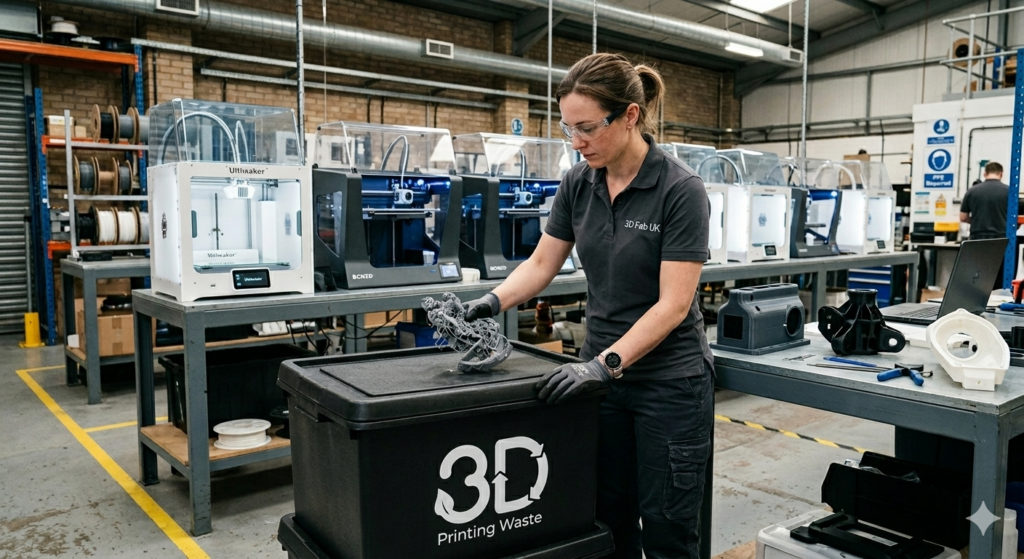
Manufacturing organisations increased their recycling activity by over 26% year-on-year and now account for roughly 30% of all scheme submissions. For a sector that has historically been slower to engage with circular economy thinking in additive manufacturing, this shift is notable.
For manufacturers, 3D printing has evolved from a prototyping tool into a production asset — which means waste volumes are real, recurring, and increasingly subject to environmental accountability. Companies from sectors as varied as marine technology, precision engineering, defence supply chain, fire safety systems and lighting are now integrating regular filament waste returns into their operational workflows.
There’s a compliance dimension here too. As ESG reporting requirements tighten across UK industry, the ability to evidence responsible disposal of materials — even relatively low-volume streams like PLA waste — becomes commercially relevant. A structured, third-party scheme with documented collection and processing provides exactly the kind of audit trail that sustainability reporting increasingly demands.
3D Printing Service Bureaus: Recycling as a Competitive Edge
Professional 3D printing service bureaus grew their participation by over a third compared to the prior year. This cohort is particularly well-positioned to leverage sustainability credentials commercially. Service bureaus process filament on behalf of clients, meaning their waste volumes and their environmental visibility are both high. Bureaus that can demonstrate responsible end-of-life material handling — backed by a documented scheme — have a tangible differentiator to offer clients navigating their own procurement and supply chain sustainability criteria.
UK-leading 3D Print Manufacturer, Midlands 3D Printing, is one of several Service Bureau’s that have used the PLA Recycling Scheme in the past.
What Really Happens to Recycled PLA 3D Printing Waste?
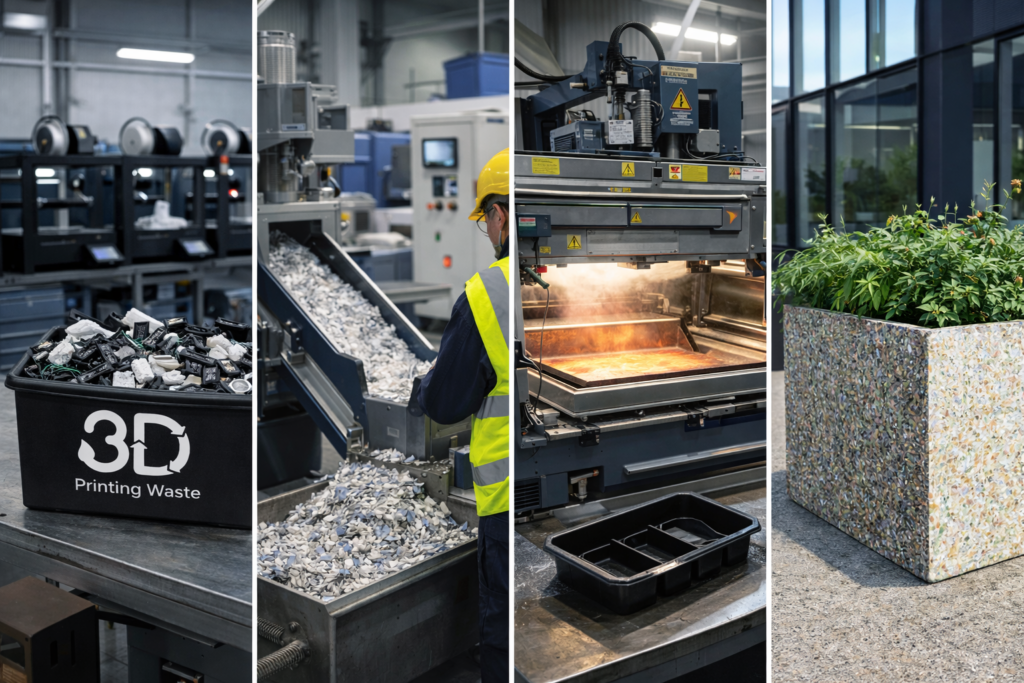
This is a question we hear regularly, and it matters. Sending waste to a recycling scheme is only meaningful if that waste is genuinely being processed into something useful — not simply diverted to a different kind of landfill.
Through our partner 3D Printing Waste (3DPW), every box returned through the scheme undergoes responsible processing via one or more of three pathways:
Upcycling into value-added products. PLA waste is used as an input material for the production of creative, functional items — giving plastic waste a genuine second life rather than simply reprocessing it back into a raw material. Examples include recycled plastic planters for public and commercial spaces, produced by Future Makers, and paint trays manufactured using blended recycled material.
Feedstock for manufacturing processes. Waste PLA is supplied as raw feedstock for processes such as injection moulding, reducing reliance on virgin polymers in manufactured goods. This is a direct substitution of new plastic with recovered material — a meaningful contribution to reducing the industry’s overall consumption of primary resources.
Pelletising for secondary materials markets. Plastic waste is shredded, melted and reformed into pellets, which are then sold as secondary materials for use in a range of downstream applications. This increases the proportion of recycled polymers in active circulation and creates a genuine economic incentive for ongoing waste collection.
The longer-term aim is a fully circular model in which returned waste is transformed back into filament. The technical challenges of maintaining the quality standards required for high-performance 3D printing filament make this genuinely difficult to achieve at scale today — but it remains the direction of travel, and 3DPW’s work represents the most viable current pathway towards it.
The Future of PLA 3D Printing Waste Recycling in the UK

The 2025/26 data points to three clear trajectories worth watching as the scheme matures.
First, institutional and industrial users are beginning to treat PLA recycling as an operational norm rather than a discretionary extra. The increase in average returns per organisation is the most concrete evidence of this shift.
Second, new entrants continue to join year-on-year, demonstrating that the ceiling on participation is nowhere near being reached. The scheme is still in a strong growth phase — and there’s no structural reason that growth should slow.
Third, the 2.5 tonnes of waste diverted from landfill since April 2024 is a number that will keep rising. For every organisation that returns a box, real material is being kept out of general waste and put to productive use. We’re proud of that number — and determined to keep building on it.
If you’re a Filamentive customer generating PLA waste — failed prints, support material, reel ends, filament offcuts — the scheme is open to you now. Spending £500 or more on PLA filament with us makes you eligible for a free recycling box. It takes minutes to arrange, and the impact is real.
Ready to recycle your PLA 3D printing waste? Learn more about our free recycling scheme or get in touch with the Filamentive team to get started.