

Most PLA 3D printing waste in the UK has historically ended up in landfill. That’s the reality our recent customer research uncovered—and it’s a stark reminder that, while 3D printing is often seen as a more sustainable manufacturing method, the end-of-life stage of materials has long been overlooked.
Most UK 3D printer operators simply haven’t had access to viable recycling solutions. Those that do exist are often too expensive or logistically difficult for businesses to adopt. This is why, in April 2024, we launched the UK’s first free PLA 3D print waste recycling scheme—a practical way to reduce plastic pollution and help organisations meet their sustainability objectives without added cost or complexity.
Now, one year on, we’re proud to share that we’ve recycled over 1 tonne of PLA waste, directly diverting it from landfill and giving this material a second life, via our partner, 3D Printing Waste. More importantly, we’ve spoken to operators using the scheme to understand its impact—insights that reveal how meaningful change is happening across the UK’s 3D printing landscape.
Which Operators are Recycling 3D Printing Waste in the UK?
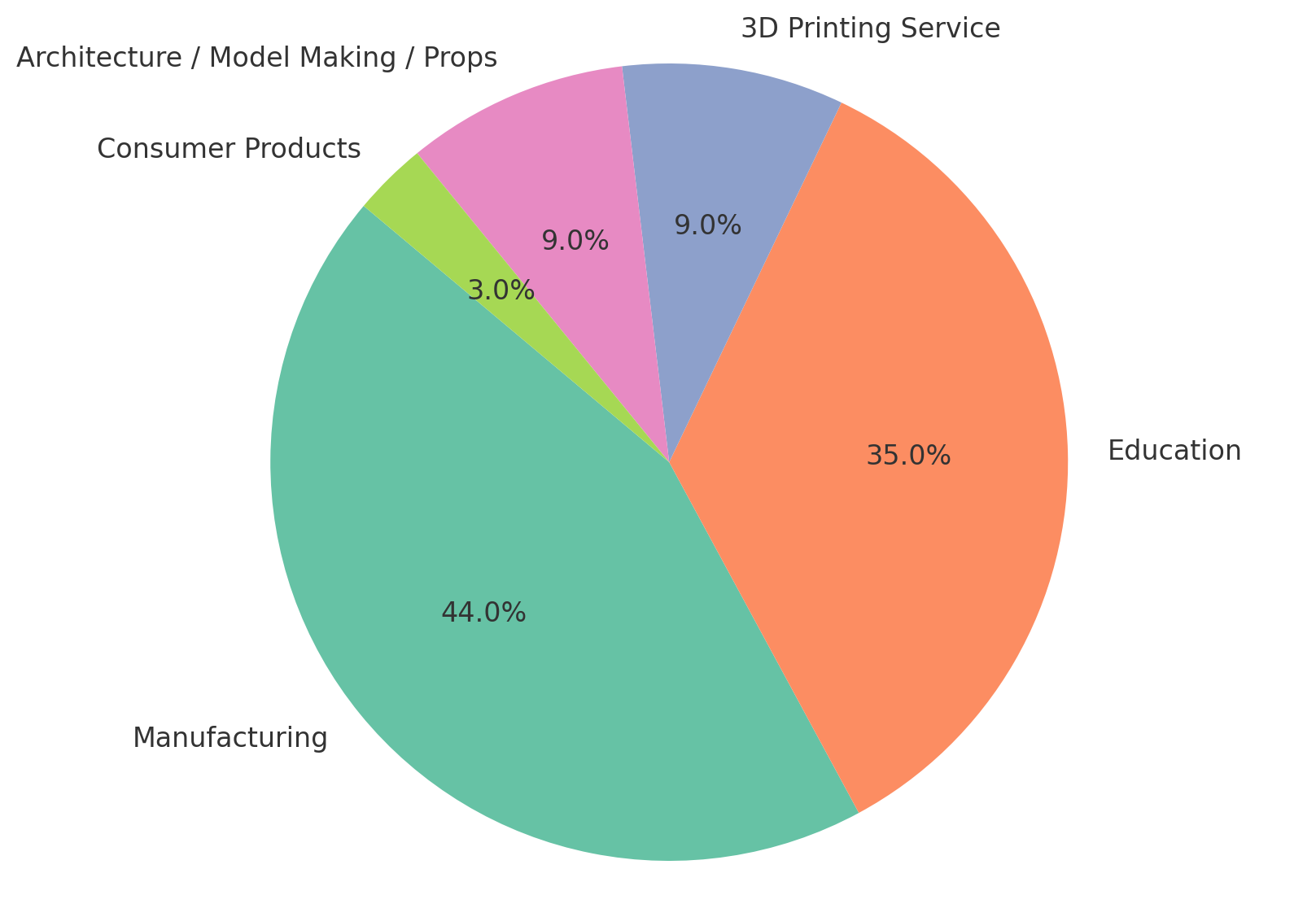
The majority of those using the scheme are from high-usage sectors, where 3D printing plays a central role in daily operations. Manufacturers make up the largest group—over 44%—reflecting both high print volumes and a growing push to align with internal and client-facing sustainability targets. Educational institutions account for a third of scheme users. With multiple printers and increasingly robust environmental policies, many universities and colleges are prioritising responsible material management.
We also saw notable uptake from 3D printing service providers, architecture firms, and model-making studios—industries where waste volumes are high, and sustainability credentials are becoming a competitive advantage. Even among businesses producing consumer goods, there’s growing pressure from end customers to demonstrate environmental responsibility. The consistent theme? An eagerness to reduce waste, and a clear appetite for solutions that are easy to adopt and genuinely make a difference.
How is 3D Printing Waste Typically Managed by UK Operators?
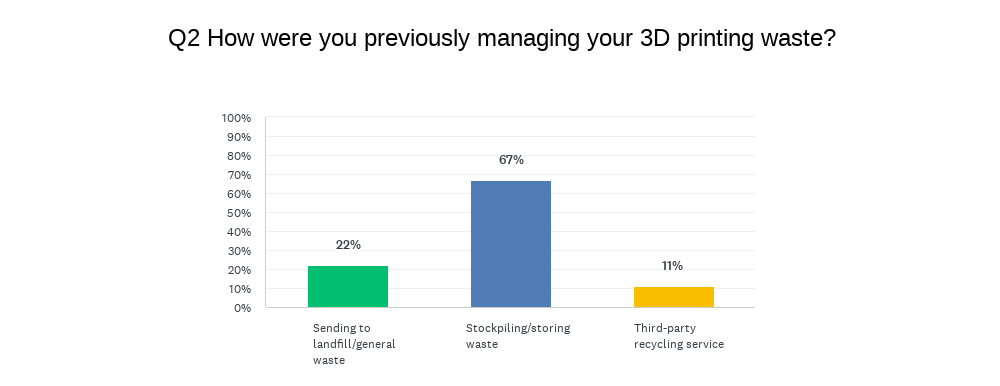
Prior to our scheme, most operators were forced to dispose of PLA in general waste—our survey showed this was the case for around 61% of users. However, when asked more directly, only 22% admitted that their PLA definitely went to landfill, while a much larger group—67%—revealed they were stockpiling it in the hope that a viable recycling option would emerge.This suggests that 89% of PLA 3D printing waste was previously not recycled.
Only 11% were able to access third-party recycling services previously. This paints a clear picture: for the majority, sustainability wasn’t a lack of intent—it was a lack of access.
PLA 3D Printing Recycling in Action: The Results so far
Since launching the scheme, operators now report recycling an average of 90% of their PLA waste—a tenfold improvement compared to previous behaviours. Based on pre-scheme data, where nearly 9 out of 10 respondents weren’t recycling, we can now infer that the volume of PLA sent to landfill has dropped dramatically, down to just 8.9%.
For organisations seeking to meet Net Zero targets, reduce operational waste, or simply free up space otherwise taken by bags of unused scrap, this shift is both environmentally and practically beneficial.
What are the Benefits of 3D Print Waste Recycling in the UK?
What’s been particularly encouraging is how seamlessly the scheme has been adopted. Operators tell us they appreciate the ease of use—whether it’s freeing up valuable space in offices and workshops, simplifying waste management, or supporting certification schemes such as Green Mark. More broadly, it allows teams to embed sustainable practice into their everyday workflows without disruption. It’s not just the environment that benefits—it’s your workplace, your brand, and your peace of mind.
Looking Ahead: What do UK 3D Print Operators want next?
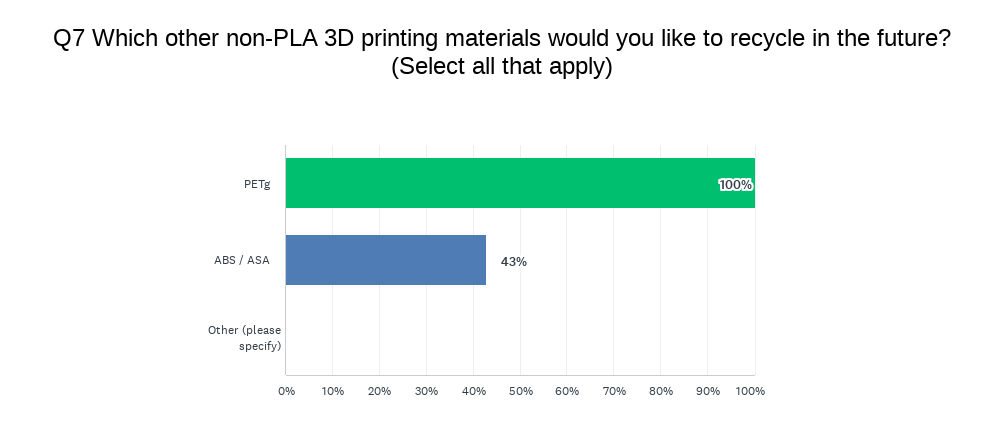
The interest in recycling doesn’t stop at PLA. Every respondent expressed a desire to recycle PETg, which is unsurprising given it’s the second-most-used 3D printing material in the UK. There’s also strong interest in finding end-of-life (EoL) solutions for ABS and ASA, particularly among organisations that 3D-print functional parts or outdoor applications.
This feedback validates our future roadmap: expanding the recycling scheme to other high-volume materials and continuing to support a truly circular approach to 3D printing.
3D Printing Waste: Towards a Circular 3D Printing Future

Filamentive’s free PLA recycling scheme is making recycling more accessible, more affordable, and more impactful. We’ve removed the financial and logistical barriers that once stood in the way of responsible waste management, helping dozens of UK 3D printer operators significantly reduce their environmental footprint.
More than just a service, the scheme is part of a wider commitment to sustainable innovation—helping our customers lead by example, meet ESG goals, and make 3D printing part of a truly circular economy.
We’re proud to be driving this change—and we’re just getting started!