
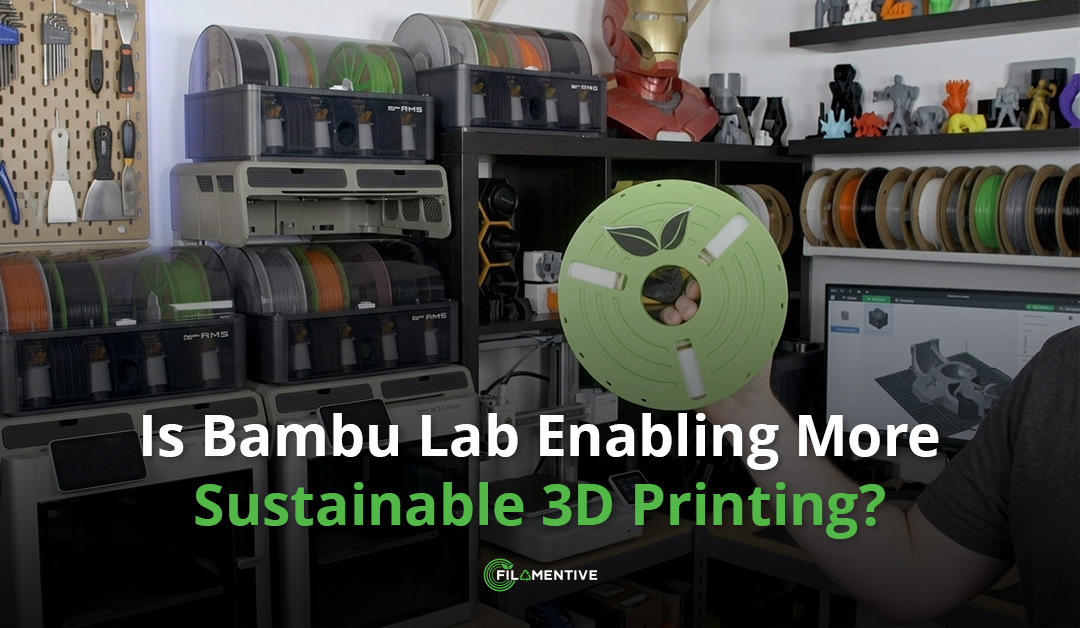
So has Bambu Lab actually made 3D printing more sustainable, or has it mostly made people print more? The honest answer sits somewhere in between: the ecosystem has normalised several genuinely waste-reducing behaviours, but none of them work automatically. What a user does with the tools determines the outcome far more than the tools themselves.
Bambu Lab Has Changed Desktop 3D Printing in the UK
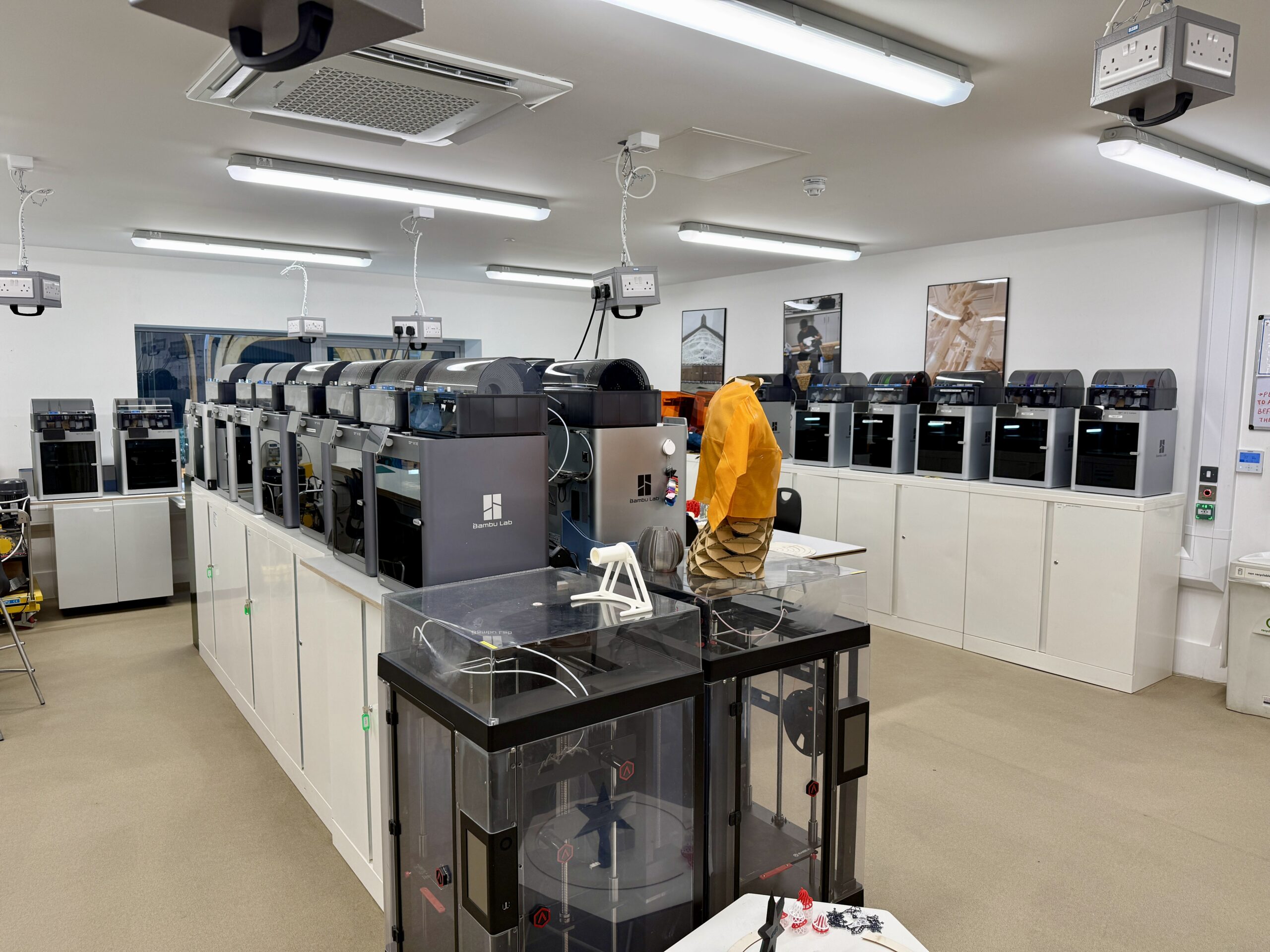
In Filamentive’s survey of 129 UK customers, Bambu Lab was the most commonly used printer brand, selected by 42% of respondents — ahead of Prusa (30%), Creality (22%) and UltiMaker (10%). Respondents could select more than one brand, so this reflects usage overlap among Filamentive’s own customer base rather than a representative UK market-share study.
What’s more interesting than the number itself is where we’ve seen it show up. Bambu adoption has grown noticeably among our Higher Education and professional customers specifically, and in most cases it isn’t a straight swap of one older printer for one new one. It’s the arrival of a small fleet — three, five, ten machines — where there used to be one. Five printers running regularly create a very different material relationship than a single prototyping machine that gets switched on occasionally. We wouldn’t claim that pattern holds across the whole UK market, but it tracks with what VoxelMatters has reported at industry level: desktop and consumer printing, with Bambu Lab prominent among it, now account for most of the polymer AM market’s current growth.
Automation Reduces One of 3D Print’s Biggest Waste Sources
Failed prints are a genuinely large source of 3D printing waste. In Filamentive’s original material-sustainability survey, more than 80% of respondents identified failed prints as one of the biggest causes of waste in their own printing.
The material cost of a failure depends entirely on when it happens. A failed first layer wastes a few grams and twenty minutes. A failure twelve hours into a long print can waste hundreds of grams of filament, plus the electricity and operator time already spent getting there.
This is where Bambu Lab’s automation genuinely earns some credit — with a caveat worth stating clearly. The flagship X1-series printers (X1C, X1E) include a built-in AI camera and a LiDAR sensor that inspects the first layer and watches for the kind of print failure known in the community as “spaghetti,” pausing the job automatically if it’s detected. That’s a meaningful reduction in exactly the kind of multi-hour, high-material failure that does the most damage. It’s not a feature every Bambu Lab printer shares, though — entry-level models in the A1 and P1 ranges don’t carry the same LiDAR-based first-layer inspection, so the sustainability benefit of this specific feature depends on which printer in the range you’re actually running. Worth checking the spec of your own machine rather than assuming the flagship feature set applies across the board.
None of this eliminates failed prints. It catches some of them earlier, which is a genuinely useful reduction in material loss — not the same thing as solving the problem.
Bambu Lab Has Helped Normalise Reusable Filament Spools
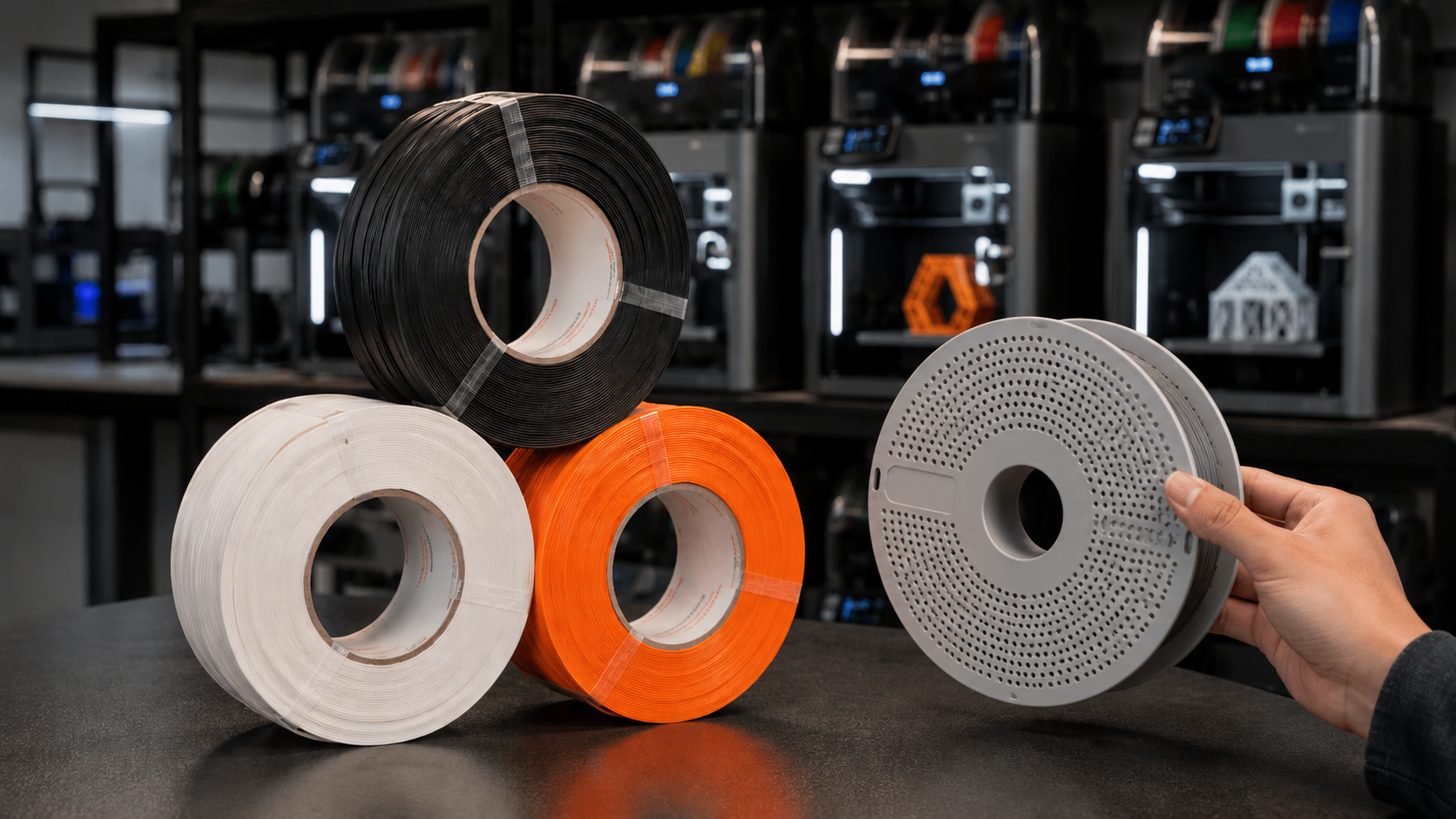
The traditional filament purchase is simple and wasteful in a way most users never stop to notice: buy a kilogram of filament, receive another plastic or cardboard spool with it, and end up with an empty spool once the material’s used. Filamentive’s own research has flagged this before — empty spool waste is one of the more overlooked plastic streams in desktop 3D printing, precisely because it doesn’t look like “waste” the way a failed print does.
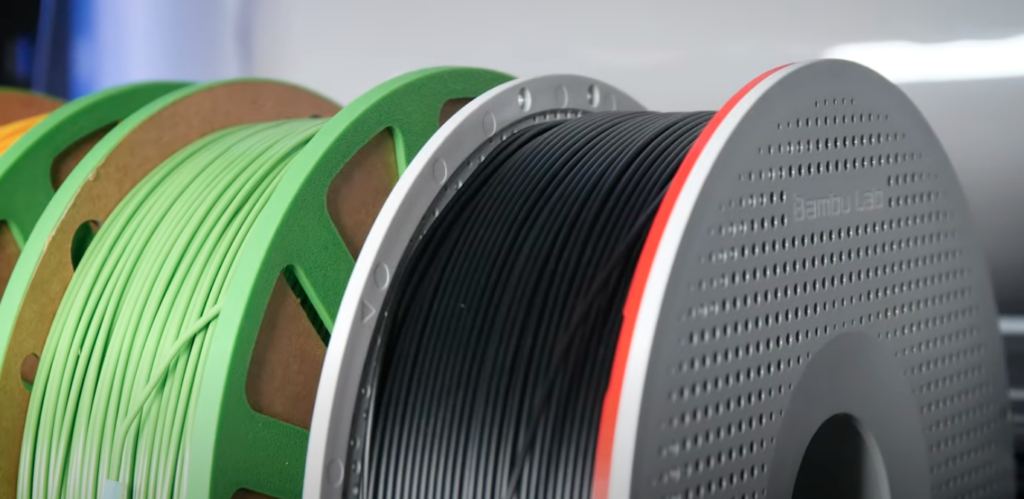
Bambu Lab’s AMS and reusable spool system haven’t solved that on their own, but they’ve done something arguably more useful: they’ve made spool reuse a mainstream, default part of the workflow rather than something only sustainability-minded users went looking for. Once a user owns a reusable spool for their AMS, refilling it rather than buying a new disposable one with every kilogram becomes the obvious choice, not an extra effort.
That’s the direct opening for Filamentive ReFill, launched in 2024 and updated to ReFill v2 specifically to fit directly onto the Bambu Lab reusable spool. ReFill is supplied without a conventional disposable spool — the filament arrives, the existing spool stays in use, and the net packaging per kilogram drops as a result. It’s relevant beyond AMS users too, for anyone running a reusable or master spool setup, but the fit with Bambu Lab’s ecosystem specifically is what’s made it one of our fastest-growing filament formats.
Better Slicing Can Prevent Waste Before the Printer Starts
Some of the most useful sustainability gains in this ecosystem happen before any filament leaves the nozzle. Bambu Studio gives an operator considerably more visibility than older slicers typically did — material and print-time estimates, previews that flag awkward geometry or heavy support requirements, and enough detail to catch an over-engineered print before it’s committed to plastic.
It doesn’t catch every poorly set up print automatically, and it shouldn’t be treated as a safety net. What it does well is make the cost of a decision visible in advance — this support structure will use this much material, this layer height will add this much time — which is a different and arguably more useful thing than automated correction. Preventing unnecessary plastic from being extruded in the first place is a better outcome than working out what to do with it afterwards.
Bambu Studio Is Becoming Smarter About Colour — and Material Use
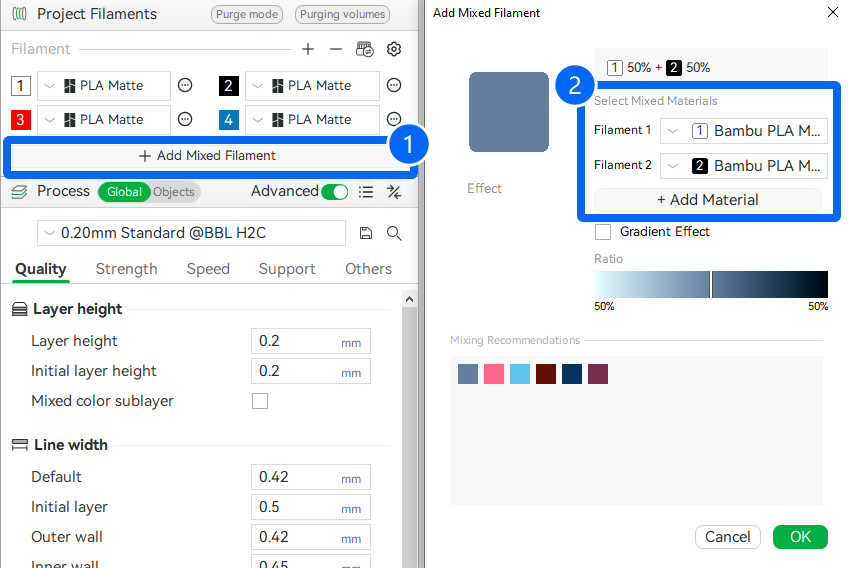
Bambu Studio introduced a genuinely interesting feature in April 2026: Color Mixing, which lets a printer combine two or three loaded filaments in a controlled ratio to produce a new visual shade. It’s worth being precise about the mechanism, because it’s easy to misread. The software does not physically melt separate filaments into a new, homogeneous spool. It layers thin sub-layers of each colour within the print itself, using an optical effect — closer to halftone printing than to blending paint — so the eye perceives an intermediate shade.
The interesting angle here is that it could let a user get more visual range out of a smaller physical colour collection, rather than buying a dedicated spool for every shade they might want. Bambu Lab’s own release notes are candid about the trade-off, though: single-nozzle printers are explicitly flagged as a poor fit for the feature, “due to frequent colour changes and increased filament consumption.” Whatever is gained in colour flexibility can be lost just as quickly in purge material if the feature is used on the wrong hardware. It’s a genuinely clever tool, not an automatic waste reduction.
The Counterargument: Multi-Filament Printing Can Be Wasteful
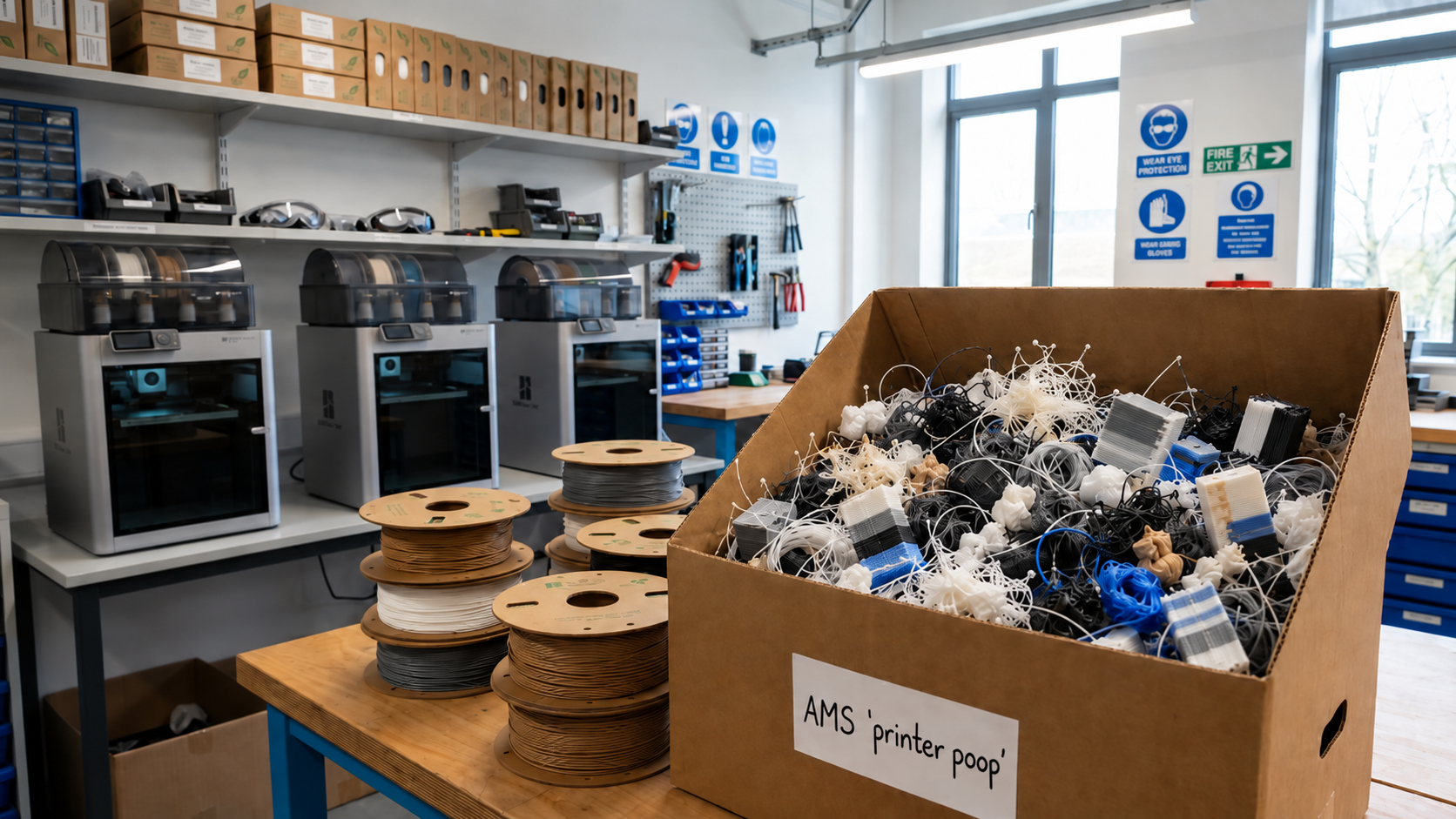
This is the part of the picture that shouldn’t be softened. AMS has made multi-colour printing dramatically more accessible — but on a single-nozzle printer, every filament change means retracting the old material, loading the new one, and purging the transition through a prime tower or waste chute before clean colour comes through. One documented example from the Bambu Lab community forum put a 90g multi-colour print at 180g of purge waste on top — close to doubling the material footprint of the finished part.
That’s not an indictment of Bambu Lab specifically; it’s a physical consequence of single-nozzle multi-material printing, shared by every slicer and printer that attempts it. But it means a highly efficient single-colour Bambu print and a heavily colour-swapped AMS print can sit at completely different points on a sustainability scale, despite coming off the same machine.
The right question isn’t “is AMS sustainable” — it’s “how is AMS being used, and how many colour changes does this specific print actually need.”
Bambu Studio includes several official settings aimed directly at this problem. Reducing the flushing-volume multiplier cuts the amount purged at each colour change. “Flush into objects’ infill” and “flush into support” redirect purged material into the model’s own interior or support structures — material that was going to be printed anyway — rather than into a separate purge tower that gets thrown away. One independent test (Micro Center) reported cutting wasted filament by more than half using exactly this combination of settings.
The trade-off is real and worth stating plainly: flushing into infill isn’t appropriate for translucent or light-coloured filament, where the mixed colour can show through the walls, and Bambu’s own documentation warns against it in those cases. Purge reduction should be evidence-led rather than maximised blindly — set flushing volumes too low and colour contamination, rather than waste, becomes the problem.
What Happens to the 3D Printing Waste You Cannot Prevent?
Even a well-optimised Bambu Lab setup still generates waste that can’t be designed away — failed prints, support structures, purge material, test iterations, and filament that reaches the end of a spool. The waste hierarchy that applies here is a familiar one: avoid using material you don’t need, reduce what you do use through better design and slicing, reuse spools and hardware where it’s practical, and recycle whatever’s genuinely unavoidable.
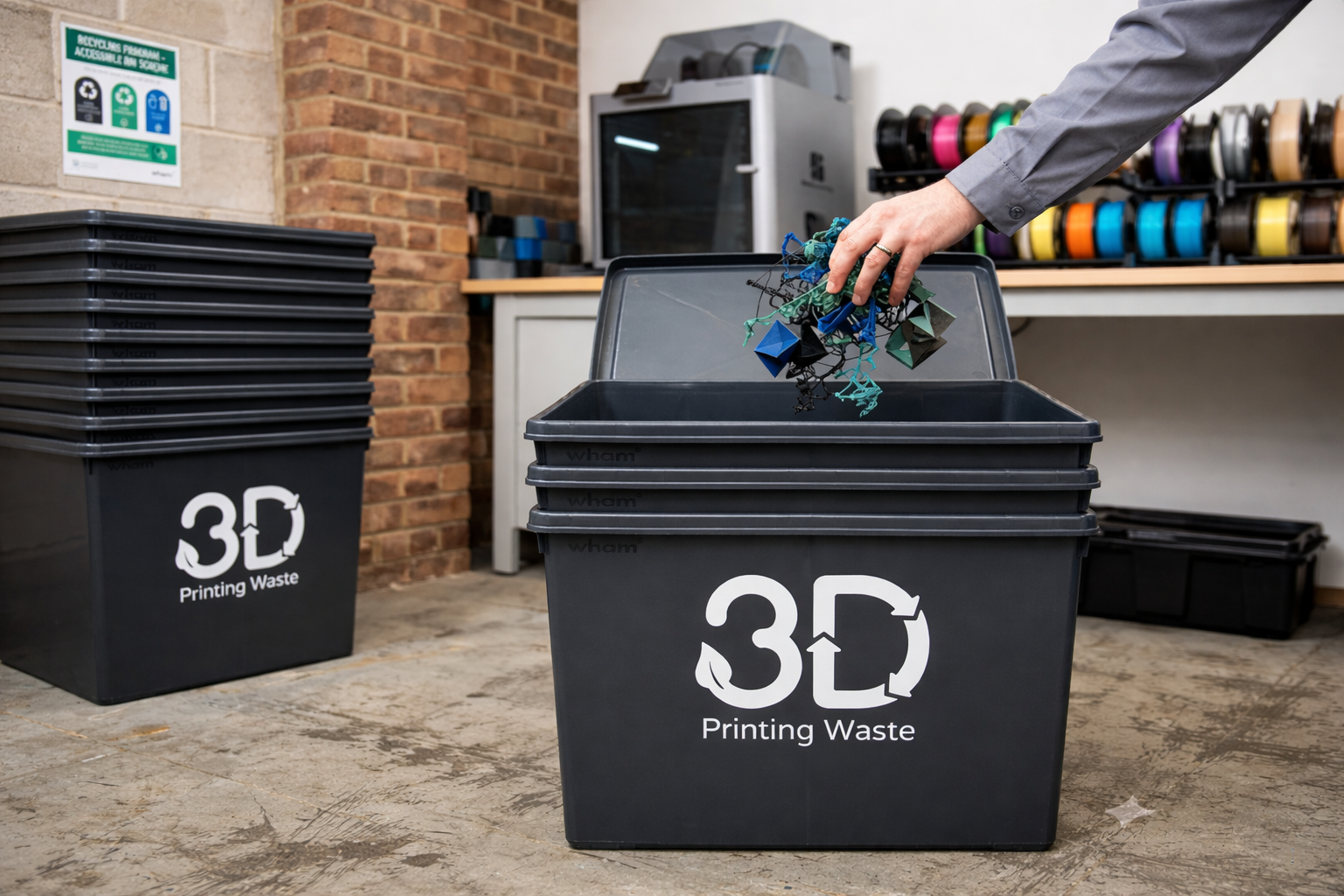
That’s the gap Filamentive’s free PLA recycling scheme exists to close. Eligible UK customers can send back their PLA waste — including AMS purge material, failed prints, supports, prototypes, offcuts and end-of-spool remnants — for recycling rather than general waste. By April 2026, Filamentive had diverted 2.5 tonnes of PLA 3D printing waste from landfill through the scheme; worth checking the current figure and current eligibility terms before quoting either externally, since both move. The point isn’t the scheme itself so much as what it represents: hardware and software can reduce waste upstream, but somebody still has to own what happens downstream, and that’s rarely built into the printer’s own ecosystem.
Is Bambu Lab Making 3D Printing More Sustainable in the UK?
Bambu Lab deserves real credit here. Automation on its flagship models can catch some of the most material-costly failures before they run their course. Reusable spools have gone from a niche habit to a default workflow. Modern slicing exposes material cost before it’s committed. Even the colour-mixing feature, for the right hardware, can mean fewer physical spools bought for the same visual range.
None of that makes a print sustainable on its own. Faster, more capable printers make it easier to print more, not just to print better. Multi-colour printing on the wrong hardware can generate purge waste that rivals the part itself. A reusable spool achieves nothing if the user keeps buying a new disposable one anyway. And even the best-run fleet still produces supports, failed attempts and end-of-life parts that need somewhere to go.
The fair conclusion is that Bambu Lab has built an ecosystem that can enable more sustainable 3D printing. Whether it actually does comes down to the choices made on top of it — which filament, which slicer settings, which spool format, and what happens to the material once a part is done.