
“Biodegradable” and “compostable” sound like the responsible choice on a filament spool. In practice, both words are doing far less work than most buyers assume — and using them as a disposal plan rather than a material description is where things go wrong.
Biobased, biodegradable and compostable get used almost interchangeably in 3D printing marketing. They are not the same claim, and UK government guidance on bio-based, biodegradable and compostable plastics is explicit that none of them should be read as shorthand for “better for the environment” or “fine to throw away.”
What these words actually mean
Biobased describes where a plastic comes from — plant starches, cellulose, lignin and similar sources — rather than what happens to it afterwards. The government’s standards guidance is clear that a bio-based origin says nothing about biodegradability or a lower environmental footprint — some bio-based plastics are blended with fossil-based polymer, and the feedstock itself carries its own land and water use considerations.
Biodegradable means a material can break down into water, biomass and gases such as CO2 and methane — but only under the right conditions of temperature, humidity, oxygen and the presence of the right microorganisms. The same guidance notes that lab test results don’t reliably predict how a material behaves in the open environment, and that biodegradable labelling shouldn’t be read as licence to discard something outdoors.
Compostable is a subset of biodegradable, specifically meaning breakdown under composting conditions. Industrial composting — typically 55–70°C, high humidity, controlled oxygen — is the scenario most compostability standards are built around, and it is a meaningfully different environment from a garden heap or a kitchen caddy. Material that breaks down industrially may not break down at home at all.
The CMA’s guidance for businesses on making environmental claims treats exactly this kind of ambiguity as a red flag: a claim needs to be clear about what it applies to and under what conditions, not left to sound more favourable than the evidence supports.
What PLA’s biodegradability does — and doesn’t — mean
PLA (polylactic acid) is the material most associated with “biodegradable 3D printing material” and it’s worth being precise about what that actually buys a UK user in practice: not much, outside a specific facility.
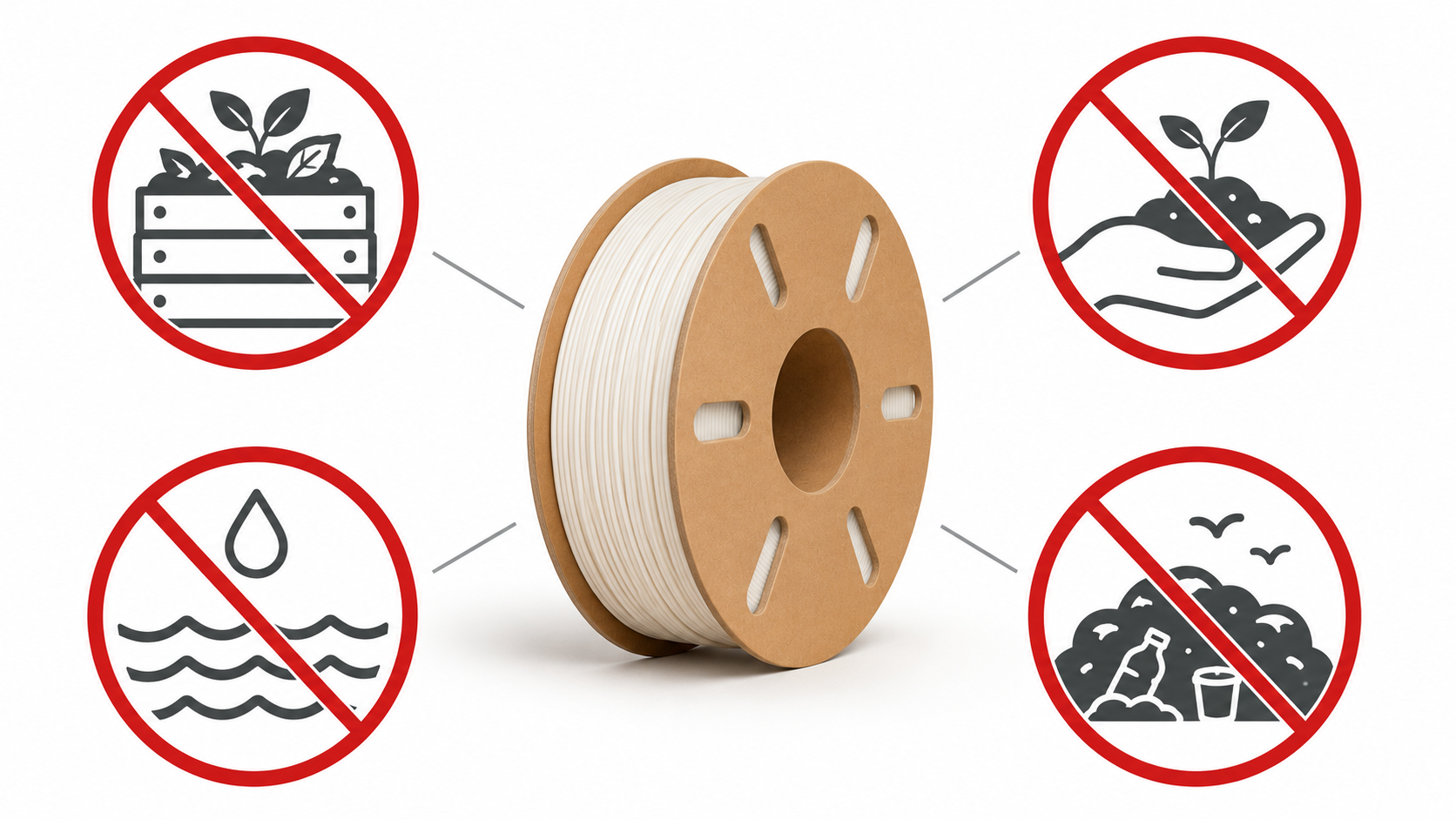
PLA does not meaningfully biodegrade in a garden compost heap, in soil, in water, or in a landfill, where oxygen and temperature are far below what triggers breakdown. It needs sustained industrial composting conditions to behave the way “biodegradable” implies, and most UK households and businesses simply don’t have access to that infrastructure for 3D-printed parts specifically — PLA is also not accepted in standard UK kerbside recycling, since it’s a different polymer family from the PET and HDPE that household recycling streams are set up to sort.
Calling PLA “biodegradable” is accurate as a lab-tested property of the raw material, and genuinely misleading as a disposal plan, if nothing in the chain between the printer and the bin actually supports it. Filamentive doesn’t claim PLA will quickly break down in home compost, soil or landfill — see our own guide to biodegradable filament — and we’d encourage any buyer to treat “biodegradable” on a spool label the same way: as a property under test conditions, not an instruction for what to do with the finished print.
Industrial composting vs home composting filament
The gap between these two is the single most important thing to understand before taking “compostable” at face value.
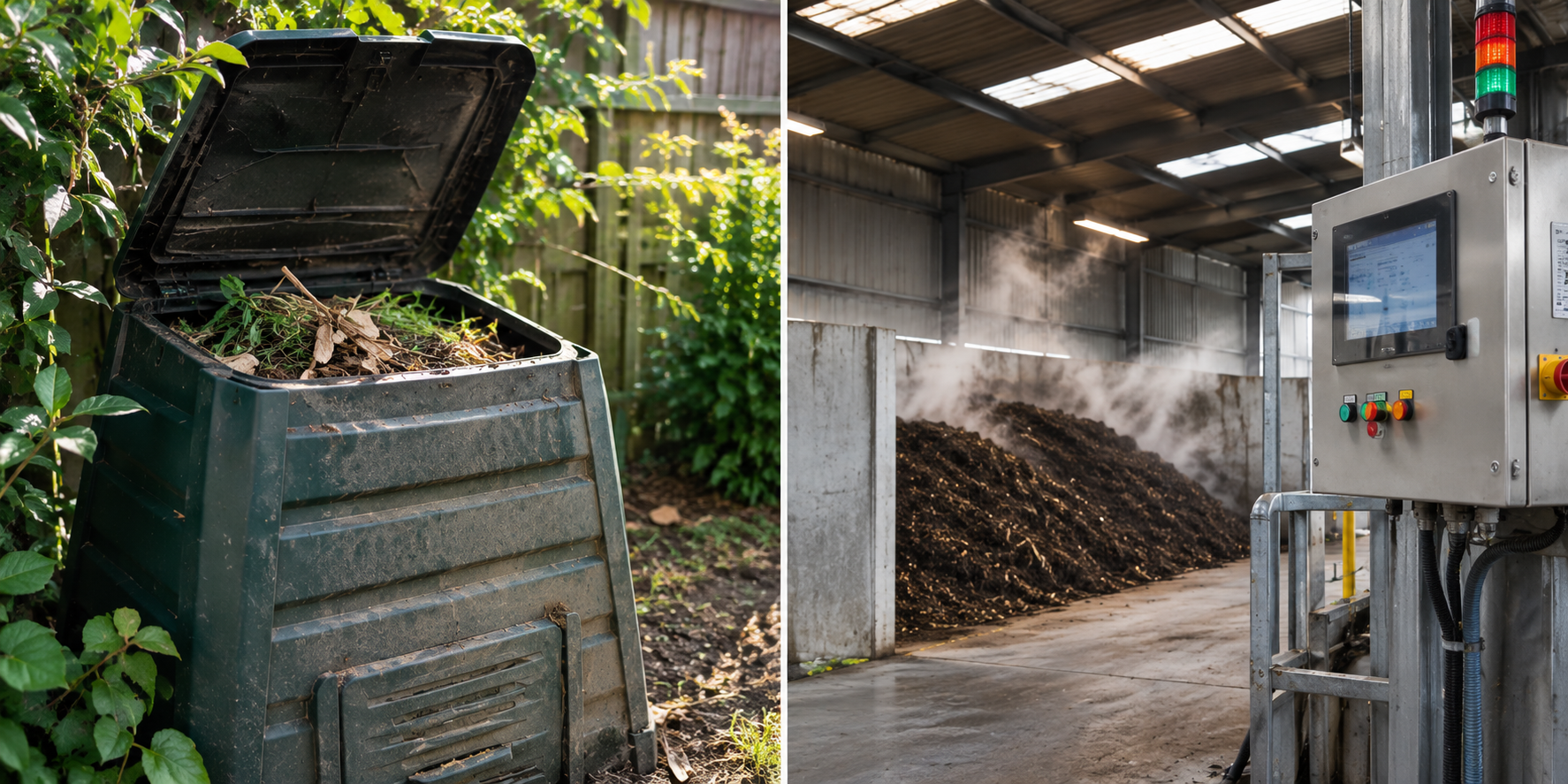
Industrial composting facilities run at controlled high temperatures, with managed aeration, moisture and microbial activity, sustained for long enough to break down plastics engineered for exactly that process. A garden compost bin does none of this reliably — temperatures rarely get close, and conditions vary with weather and what else is in the heap.
In the UK, council collections set up for composting are generally limited to garden waste — grass cuttings, hedge trimmings, leaves and similar — rather than a general collection for compostable plastic. There is no routine household composting bin for plastic waste of any kind, biodegradable claim or not, so a compostable spool or print has no obvious domestic route into an industrial composting system. Before assuming a compostable claim means a real disposal route exists near you, it’s worth checking directly with your local authority or waste provider rather than assuming garden waste collection will take a 3D-printed part.
Bio HT Filament: what the claim actually covers
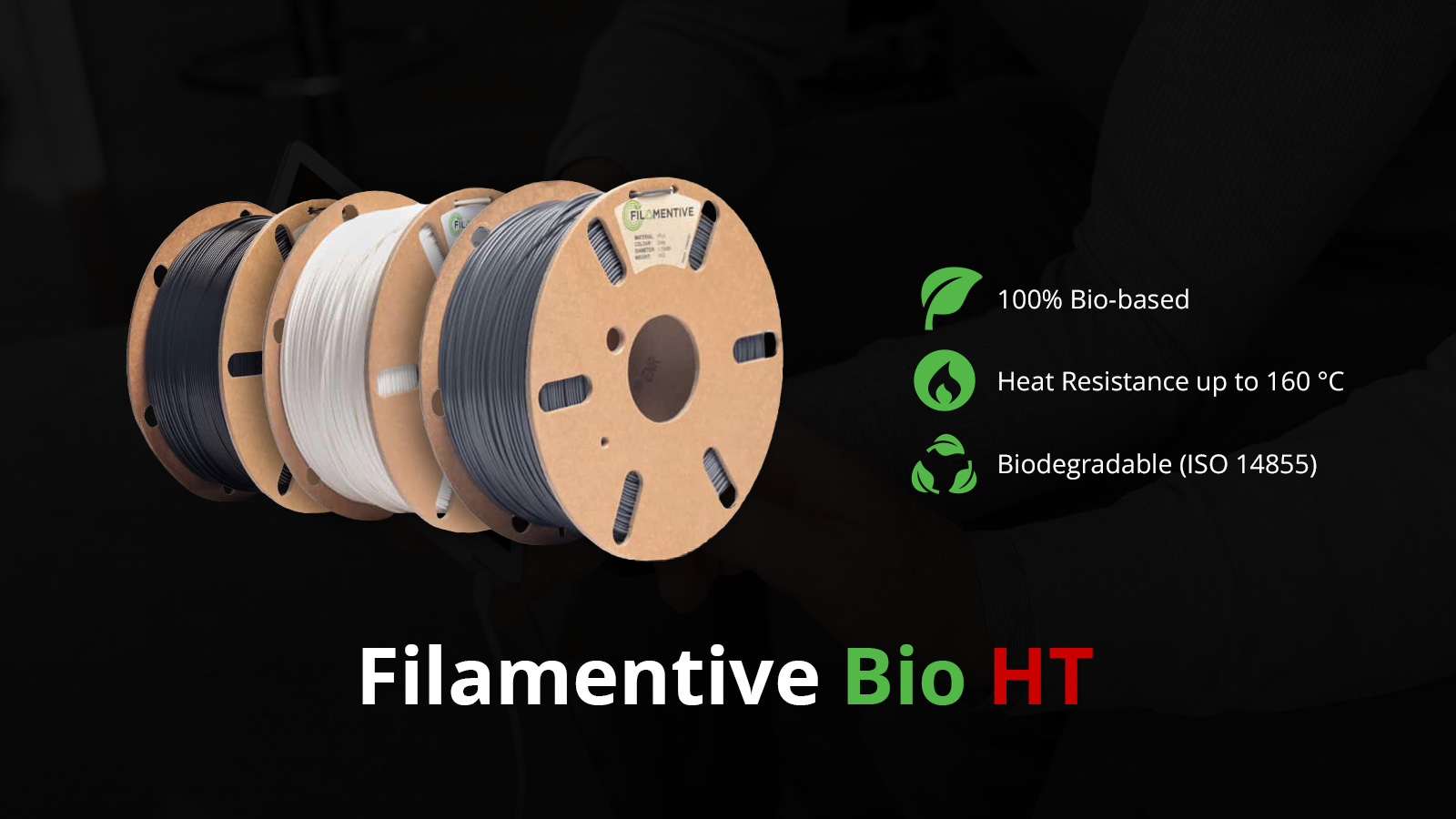
Filamentive’s Bio HT is a bio-based polymer filament built for higher-temperature applications than standard PLA. Filamentive describes Bio HT as a Certified Biodegradable filament, with biodegradability tied to the base polymer and referenced against ISO 14855, the standard that measures aerobic biodegradation of plastics under controlled composting conditions, via the CO2 released and the degree of material breakdown during the test.
Two things are worth being exact about here, because they’re easy to blur in marketing copy and we’d rather state them precisely than let the claim run ahead of the evidence.
First, ISO 14855 itself is a test method, not a certifying body — it describes how a biodegradation test is run and what it measures. Whether a specific material meets a formal certification depends on the acceptance criteria of a certification scheme (such as EN 13432, which uses ISO 14855 as one of its test methods) and the certificate issued by an accredited body against that scheme. Filamentive’s “Certified Biodegradable” description for Bio HT reflects the company’s own classification of the base polymer against this standard.
Second, the claim applies to the base polymer, not automatically to the finished filament, every colour variant, or a printed part. A test on raw polymer resin doesn’t necessarily transfer to a spooled, pigmented, extruded product without separate verification — this is a genuinely common gap in how “biodegradable filament” gets marketed across the industry, not a Filamentive-specific issue, but it’s one we think buyers deserve to know about.
In practice, that means: Bio HT’s biodegradability is a property of its bio-based base polymer, assessed under laboratory composting conditions against a recognised standard. It does not mean a Bio HT part will compost at home, in soil, or in a landfill, and like PLA, it still needs an appropriate industrial composting route to actually realise that property.
Looking for what to do with your 3D print waste in the UK?
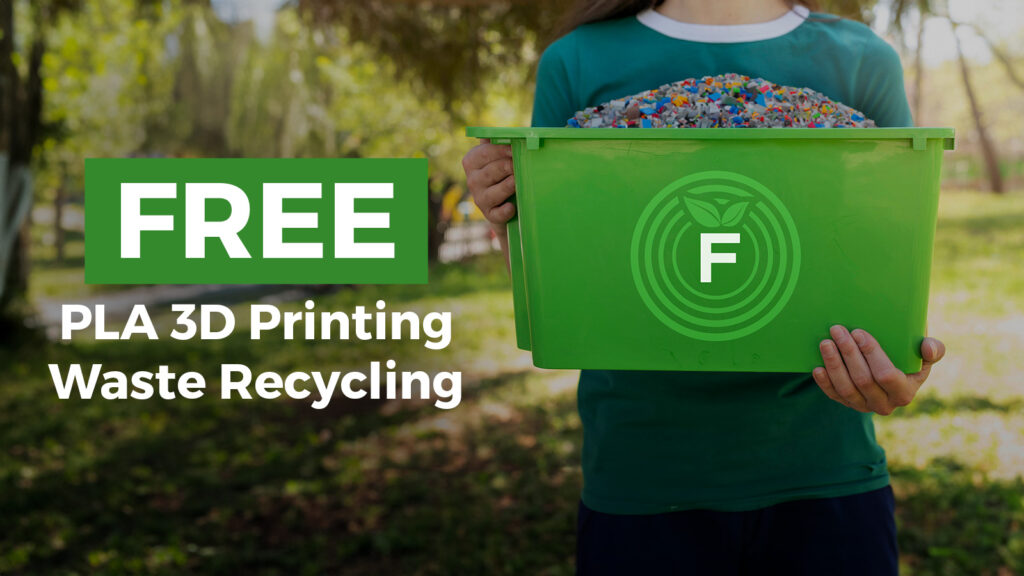
Given all of the above, the honest starting point for most UK users is this: don’t assume biodegradable or compostable filament solves your waste problem by itself. Plan for where the material actually goes.
For PLA specifically, Filamentive runs a free take-back recycling scheme for eligible UK customers. Any existing customer who has spent a cumulative £500 + VAT or more on PLA filament through filamentive.com qualifies, and the scheme accepts clean PLA waste generally — not just Filamentive-branded material — including failed prints, offcuts, supports and similar. It doesn’t accept PETg, ABS, nylon, resin, or contaminated material.
It’s worth being clear about what this scheme actually is, because it’s easy to assume more than is true. Returned PLA isn’t melted back down into new Filamentive filament — the quality and consistency requirements for virgin-grade filament production make that commercially impractical at the moment. Instead, our recycling partner, 3D Printing Waste, routes the material into other applications: upcycled products such as planters and trays, feedstock for processes like injection moulding, or pelletised material for secondary plastics markets. It’s a genuine diversion from landfill and incineration, not a closed loop back into new filament or composting.
If you’re outside the scheme’s eligibility or printing in a material it doesn’t cover, don’t assume your local general waste collection will take a 3D-printed part — check first — and treat general kerbside recycling as the wrong bin for PLA regardless of what the spool label says.
A short checklist before you buy or bin your 3D prints
Does the label say what’s biodegradable — the raw polymer, the filament, or the finished part? These are not interchangeable.
Does “compostable” specify industrial or home composting? If it doesn’t say, assume industrial, and check it’s actually named somewhere verifiable.
Is there a named standard and, separately, a named certifying body? A standard reference (like ISO 14855) describes a test method; a formal certificate against a scheme like EN 13432 is a separate document from an accredited body.
Does your local authority’s waste collection actually accept 3D-printed parts? Don’t assume — ask. Most councils don’t collect compostable plastic waste of any kind outside garden waste.
If you’re disposing of PLA waste, is there a genuine take-back or recycling route available to you – like Filamentive’s free scheme – rather than general kerbside recycling, which won’t process it?
The balanced take: biodegradable vs bio-based filament
None of this makes biodegradable or bio-based filament a bad choice — PLA and materials like Bio HT have real, practical reasons to exist, from lower reliance on virgin fossil feedstock to genuinely useful print properties. The issue isn’t the material; it’s treating a lab-tested property as a disposal instruction.
Choose a filament for what it needs to do as a printed part. Separately, plan its end of life based on verified local infrastructure and genuine take-back schemes, not the assumption that “biodegradable” on the label means it’ll quietly disappear wherever it ends up.