
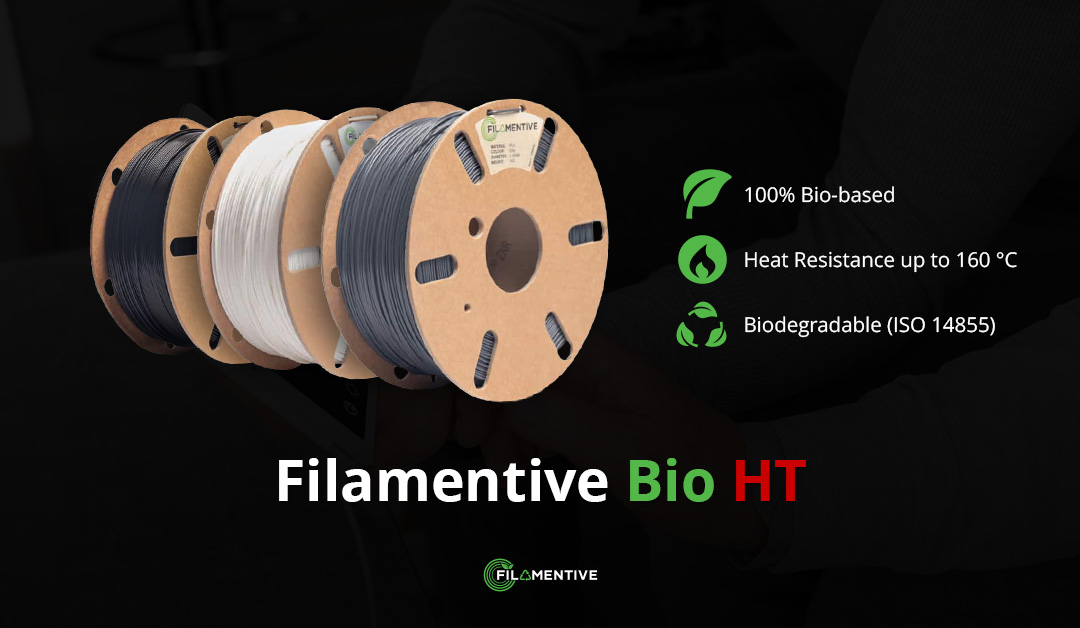
Bio HT is our bio-based, oil-free high temperature filament for functional parts that face heat and mechanical load. It meets biodegradation standard (ISO 14855), delivers dependable heat resistance, high stiffness, strong flexural and impact performance, and a clean semi-matte finish.
From November 2025, Bio HT ships in Black, Grey and White on a 100% recyclable cardboard spool, with UK stock for short lead times.
Which 3D Printing Users is Bio HT Filament for?
Engineering teams, print farms and industrial users needing a heat resistance filament that prints reliably like PLA-class materials but remains dimensionally stable when warm—ideal for jigs, fixtures, enclosures, brackets and shop-floor aids.
Key 3D Printing Material Specs at a glance
VICAT softening point (A, 4 mm): 160 °C
HDT/B (0.45 MPa): ~115 °C*
Finish: Semi-matte
Origin: Bio-based, oil-free base polymer
* Indicative values from standard test specimens. Real-world performance varies with part design, orientation, infill, wall thickness, print parameters and post-processing.
A Biopolymer Filament for High Thermal Performance
Bio HT is designed to hold shape and stiffness in warm environments where general-purpose filaments fall short. The combination of VICAT 160 °C (A, 4 mm) and HDT/B ~115 °C makes it a credible option for fixtures and housings exposed to intermittent or continuous heat.
Vicat softening explained
Vicat (ISO 306) measures when a plastic begins to soften under a small, constant load as temperature rises. Method A uses a 10 N load; quoting “(A, 4 mm)” makes the test conditions clear and improves comparison across materials.
Typical benchmarks versus PLA, PETG, ABS filaments
For context, standard PLA sits around ~60–65 °C, PETG ~78–85 °C, and ABS ~95–100 °C by ISO 306 (method dependent). Bio HT’s 160 °C Vicat A (4 mm) is a step change beyond these common choices.
Mechanical and 3D Printing Behaviour
Bio HT combines high rigidity with strong flexural and impact performance. Parts feel solid, hold tolerances well and present a premium semi-matte surface that helps mask layer lines—useful where appearance and function both matter.
Strength and finish
Stiff, robust parts for day-to-day use on the shop floor
Semi-matte look straight off the bed for a professional appearance
3D Printing Settings and Guidance
Printing temperature: 215±25°C
Bed temperature: 0-50°C
Keep filament dry; aim for consistent first-layer adhesion (PEI or textured plates work well)
Use moderate cooling to support interlayer bonding.
Increase wall counts and use solid infill where duty cycles demand thermal/mechanical assurance.
3D Printing Material Sustainability without greenwash
Our goal is clear, evidence-led communication—no vague claims.
Certified Biodegradable filament for 3D Printing, defined
“Biodegradable” here refers to the base polymer being biodegradable under controlled, industrial composting conditions in line with DIN EN ISO 14855. This does not mean home compostable and does not imply landfill biodegradation. Most municipal systems do not accept 3D-printed parts; check locally.
Food Safe Filament: Food-contact clarification
The base polymer holds FDA food-contact status. The finished filament, colours and printed parts have not been assessed for food-contact compliance. Conduct your own evaluation for regulated uses.
From November 2025, Bio HT is available in Black, Grey and White on our 100% recyclable cardboard spool. We hold UK stock for fast turnaround, with trade and bulk pricing options for engineering teams and print farms.