

The Bambu Boom shows no signs of slowing in the UK. As of 2024, over 42% of 3D printer users surveyed in the UK are now operating a Bambu Lab 3D printer—a remarkable figure that cements Bambu Lab’s position as the UK’s most popular 3D printer brand.
This rapid adoption is no accident. Combining ultra-fast print speeds, user-friendly software, and the smart innovation of the AMS (Automatic Material System), Bambu Lab printers are quickly becoming a mainstay across homes, schools, print farms, and businesses throughout the UK.
But what materials are people using with Bambu Lab printers? How does the AMS really work? And how can UK users get the most out of their Bambu Lab printer in 2025—without compromising sustainability or print quality?
What Materials Are Bambu Lab Users Printing in the UK?

Understanding what materials Bambu Lab users are printing with gives valuable insight into both usage trends and performance priorities across the UK 3D printing community. According to a recent survey, the most commonly used materials among Bambu Lab users are:
PLA – 96.43%
PETg – 60.71%
PLA Matte – 39.29%
ABS – 32.14%
PLA Silk – 32.14%
TPU – 28.57%
PLA Tough – 28.57%
ASA – 25.00%
Nylon – 21.43%
PLA Marble – 14.29%
PC – 10.71%
PLA Glitter / Sparkle – 7.14%
Unsurprisingly, PLA is the dominant material—used by over 96% of Bambu Lab respondents. This mirrors the findings from our broader 2025 Filamentive customer survey, where PLA was used by over 91% of users. As the most accessible and reliable filament, PLA remains the standard for everything from rapid prototyping to decorative prints.
PETg holds second place in both surveys—used by 60.71% of Bambu Lab users and 62% of Filamentive customers. Valued for its blend of strength, flexibility, and ease of printing, PETg continues to be a dependable choice for functional parts that need greater durability than PLA can offer.
Matte PLA and Tough PLA also feature prominently in both groups, showing that users are prioritising not just ease of printing, but also aesthetic finish and mechanical strength. The popularity of PLA Silk, Marble, and Glitter variants further highlights a strong demand for visually striking materials, especially among designers and hobbyists.
Notably, Bambu Lab users show a slightly higher adoption of engineering-grade materials such as ABS (32.14%), ASA (25.00%), and Nylon (21.43%), compared to Filamentive’s broader customer base. This suggests that the performance-focused capabilities of Bambu Lab printers—especially when paired with the AMS—are enabling more users to experiment with advanced materials for demanding applications.
Ultimately, the data reflects a rich and diverse material landscape. Whether for creative expression, practical functionality, or technical performance, Bambu Lab users in the UK are clearly taking advantage of the wide material compatibility their machines offer—especially when supported by AMS automation.
Understanding the AMS: The Power Behind Bambu Lab’s Flexibility
The Automatic Material System (AMS) is more than just a filament feeder—it’s a game-changer for multi-material 3D printing.
Designed to automatically switch between filaments during a print, the AMS allows for colour changes, support material swapping, and hassle-free material management. The system reduces downtime, minimises human error, and elevates the creative possibilities for 3D printing enthusiasts and professionals alike.
Bambu Lab AMS supports a broad range of materials—including PLA, PETg, ABS, ASA, PC, TPU, and more—offering flexibility for designers, engineers, and manufacturers alike.
Which filaments are AMS compatible? Do Cardboard Spools Fit?
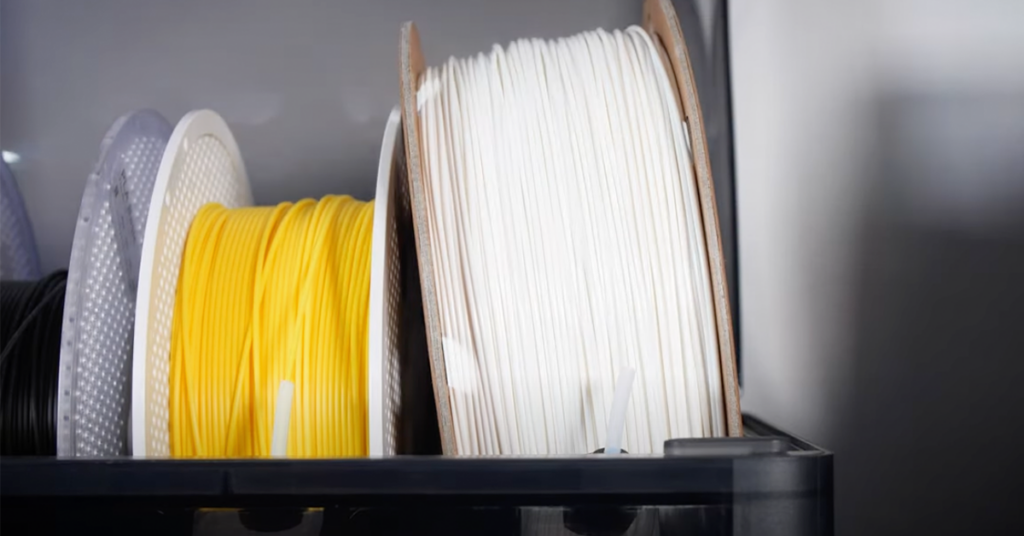
To ensure compatibility with the Bambu Lab AMS, filament spools must meet specific size requirements. The system is designed to accommodate spools with a width between 50 mm and 68 mm, and an outer diameter between 197 mm and 202 mm. Spools falling outside of these dimensions may not fit correctly, potentially affecting automated loading and print reliability.
Additionally, the AMS only supports filaments with a 1.75 mm diameter, and it is compatible with a wide range of materials, including PLA, PETG, ABS, ASA, PET, PA, PC, PP, POM, HIPS, as well as Bambu Lab’s own PLA-CF, PAHT-CF, and PETG-CF.
Filamentive is pleased to support many AMS-compatible filaments, helping users enjoy high-quality, sustainable 3D printing with seamless integration into their Bambu Lab setup.
Another one of the most frequently asked questions in the UK Bambu Lab community is whether cardboard filament spools are compatible with the AMS.
As highlighted in our original 2024 guide, 3D printing with cardboard spools using the AMS can present challenges. The friction from spinning against AMS rollers may cause cardboard particles to shed, which could lead to clogs or spool deformation, especially with extended use.
According to Bambu Lab’s own guidance, users choosing cardboard-spooled filament should consider a spool adapter. This helps reduce slippage and shields the spool edges, preventing debris build-up inside the AMS.
That said, most UK users report smooth operation when using cardboard spools, especially when simple precautions are taken—like using a spool ring adapter or choosing thinner spools that fit the AMS dimensions.
To support users opting for cardboard spools, Filamentive has collaborated with the 3D printing community to offer a free, 3D-printable spool adapter—designed specifically for Filamentive cardboard spools and the Bambu Lab AMS.
This adapter clicks into place around the spool edge, reducing wear and ensuring reliable filament feeding. It’s designed to fit within the closed AMS lid, though if the spool is slightly oversized, you may compress the spool edges gently and refit the adapter for a flush fit.
Are Third-Party, Spooled Filaments Bambu Lab AMS Compatible?
Yes—Filamentive 3D printers filaments 100% work with Bambu Lab printers and verified spools are AMS-compatible.
As of April 2025, all 1 kg cardboard spools from Filamentive are manufactured with a narrower profile specifically designed to fit inside the Bambu Lab AMS. For users of our 0.75 kg spools, the aforementioned Filamentive Spool Tire ensures a snug, reliable fit.
This means UK customers can continue to enjoy the benefits of eco-friendly packaging without sacrificing performance or compatibility.
ReFill: AMS-Compatible, Spool-Free Filament for Bambu Lab
For users looking to take their sustainability even further, Filamentive ReFills are designed to be 100% AMS compatible when used with Bambu Lab Reusable Spool.
ReFill offers all the functionality of our regular filament, without the waste and recent feedback from ReFill users shows
32% chose ReFill for AMS compatibility
50% selected it to reduce spool waste
18% appreciated the cost savings
By eliminating single-use spools, ReFill reduces both plastic and cardboard waste, lowers shipping volume, and encourages reusability in your 3D printing setup.
A Sustainable UK Filament Alternative to Bambu Lab
Filamentive’s ReFill PLA and ReFill PETg are now widely used by Bambu Lab users across the UK—offering a UK-stocked, AMS-compatible alternative to OEM filaments.
All ReFill filaments are:
– Fully AMS-compatible
– Available in a wide range of colours
– Produced with recycled materials wherever possible
– UK stock and shipped same day on free next day service
With bulk discounts (up to 30% off orders over £99) and exclusive trade pricing, ReFill is ideal for regular users, print farms, and businesses looking to reduce their environmental impact without compromising performance.
From updated spool designs to refill-ready formats, Filamentive is committed to supporting UK Bambu Lab users with reliable, sustainable, and AMS-compatible filament. Whether you’re printing prototypes, products, or passion projects, we’ve got you covered—without costing the Earth.