
PLA 3D Printer Filament

What is PLA?
PLA filament is the most popular material in 3D printing – easy to use, low warp, and ideal for everyday prints. Made from plant-based sources, it’s more sustainable than fossil-based plastics, though not biodegradable in home compost or landfill.
Filamentive PLA contains 50% recycled material, helping reduce virgin plastic use and divert waste from landfill – without compromising 3D print quality.
Showing all 4 resultsSorted by popularity
-

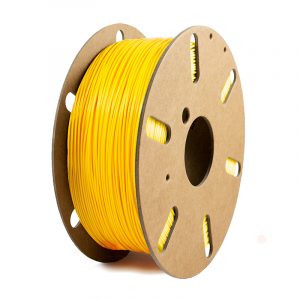
Yellow PLA 3D Printer Filament
Price range: £21.99 through £26.99 Ex. VAT -
2.3kg Yellow PLA 3D Printer Filament
£58.99 Ex. VAT -
Sale!
Pack of 10 – Yellow PLA 3D Printer Filament – 1.75mm, 1KG
Original price was: £247.99.£199.99Current price is: £199.99. Ex. VAT -
4.5kg Yellow PLA 3D Printer Filament
£108.99 Ex. VAT



Frequently Asked Questions
What is PLA filament?
PLA filament is made from Polylactic Acid – this is a plant based bioplastic which means it is made from renewable sources such as plants, rather than traditional plastic like ABS which are derived from oil-based, non-renewable sources.
PLA filament is the feedstock for 3D printing and is produced from PLA plastic in a manufacturing process known as extrusion. This creates the filament in one of two diameters – 1.75mm or 2.85mm.
Is PLA Filament food safe?
PLA is produced from a natural source and so in raw form, can be safely regarded as food safe. PLA filament is of course a finished product and the process of formulating PLA as a filament involves additives for mechanical properties, visual aspects and 3D printing performance. As such, it is impossible to say all PLA filament is food safe and it is wise to check with the manufacturer.
EU Regulation EU 10/2011 sets out safety requirements for plastic materials and articles intended to come into contact with food. Filamentive Limited declares that the version of its filament suitable for 3D printing, as mentioned below, complies with the compositional requirements according to EU Regulation No 10/2011.
PLA: Black, White, Dark Grey, Light Grey, Silver, Red, Dark Blue, Green, Yellow, Orange
The conditions and limitations of use for base polymers are defined as: “May be used with all food types, with the exception of foods containing greater than 15% alcohol, at temperatures up to 100°C followed by long-term storage at ambient temperature or below.”
Is PLA filament biodegradable?
There is no evidence to prove PLA filament is biodegradable in landfill, soil or home composting.
Based on academic research by nova-Institut GmbH, PLA is only biodegradable in industrial compost or in an anaerobic digestion facility – specifically, this is a controlled composting environment heated to 140 degrees fahrenheit and fed a steady diet of digestive microbes.
Why does PLA filament get brittle?
PLA is hygroscopic, which means that if the filament absorbs moisture from surrounding air, it can cause a variety of issues including brittleness. Furthermore, you may hear popping and cracking sounds as well as uncharacteristic stringing and blobbing during 3D printing.
To fix filament getting brittle, you can dehydrate PLA in an oven for four to six hours at a temperature of 65 degrees celsius. Please follow equipment healthy & safety guidance.
To prevent PLA filament becoming brittle, store in a cool and dry environment, away from UV light exposure. Filamentive include free grip seal bags with every order to aid storage.
Where to buy PLA filament?
PLA filament is available to buy, online, in-store collection via click & collect. FREE Next day UK delivery.
Filamentive PLA filament is available to buy via a network of resellers and stockists in the UK and beyond. See https://www.filamentive.com/resellers/ for the complete list.
Which PLA filament to buy?
Which PLA filament to buy is mainly dependent upon your 3D printing application.
Filamentive PLA is the filament to buy if you need an easy to print, low cost PLA for 3D printing.
If your 3D printing application requires enhanced impact resistance, Filamentive PLA Tough is the PLA filament to buy as it is more than 750% more impact resistant that regular PLA.
If you’re 3D printing with PLA and require greater heat resistance and increased stiffness, ePLA (engineering PLA) is the PLA filament to buy.
How is PLA filament made?
Can PLA filament be painted?
Is PLA filament toxic?
Is PLA filament recyclable?
PLA is 100% recyclable via mechanical recycling and (industrial) composting.
Once printed, PLA can be recycled by shredding the plastic parts and then using an extruder machine to manufacture 100% recycled filament from the PLA waste. Whilst technically feasible, there are many challenges to consider which were explained in this blog post.