

The world of 3D printing rarely pauses for breath, and 2025 has been no exception. Over the past twelve months we’ve seen a steady stream of material innovation – from bio-based and hemp-reinforced filaments to the return of high-performance composites designed for real-world use. At the same time, sustainability has shifted from a talking point to a practical requirement. Filamentive has been operating squarely at that intersection, releasing new materials, refining existing ranges and backing it all up with tangible circular initiatives that work at scale for UK engineers, designers and makers.
That progress didn’t go unnoticed. In 2025, Filamentive was named one of the Top 100 Additive Manufacturing Companies by 3D Evaluate – recognition reserved for businesses that are not just innovating, but actively shaping the future of additive manufacturing across industry. In Filamentive’s case, it reflects years of focused work on recycled and bio-based filaments, transparent material data, and practical solutions such as spool-less refills designed for modern systems like the Bambu Lab AMS.
As Managing Director Ravi Toor puts it: “As the 3D printing industry evolves, it’s vital that sustainability takes centre stage alongside innovation.”
This review looks back at the key material launches, sustainability milestones and industry developments that defined Filamentive’s 2025 – and why they matter for anyone serious about 3D printing in the UK.
New Materials: The Best Filament Releases of 2025
PLA Matte Filament Returns – Better Than Ever
One of the year’s earliest headlines was Filamentive’s relaunch of PLA Matte. After supply issues in 2024, this crowd favourite came back with a refined formula: it retains the velvety, non‑reflective finish that hides layer lines but prints at a lower temperature and with tighter tolerances. Available in a fresh palette of black, white, grey, blue and red, it’s ideal for architectural models, functional prototypes and decorative projects. Perhaps most importantly, every spool is 100% recyclable, making it a sustainable choice without compromising quality.
Carbon Fibre PETG: Higher Strength, Lighter Footprint
March saw the return of CF‑PETG, a composite of 85 % PETG and 15 % recycled carbon fibre. This filament offers remarkable stiffness, impact resistance and thermal stability – all wrapped up in a sleek matte black finish. Engineers and product designers love it for camera equipment, power tools and automotive parts.
Hemp PLA – A Truly Sustainable Origin Filament
If you’re looking for something genuinely different, Hemp PLA ticks all the boxes. Launched over the summer, this biocomposite blends high‑purity PLA with 10 % hemp by‑products. The result is a filament with a rustic, textured finish and visible natural flecks. It’s great for eco‑conscious product design, concept models and artistic prints. Hemp PLA prints just like standard PLA but uses less fossil‑based material, highlighting how even small changes can reduce carbon emissions.
Bio HT Filament – When You Need Heat and Strength
For engineers working on under‑hood components, consumer electronics or medical devices, Bio HT has been a game changer. This bio‑based, oil‑free polymer withstands temperatures up to 160 °C and delivers outstanding impact and flexural performance. It’s compostable under industrial conditions (ISO 14855), showing that high performance doesn’t have to come at the planet’s expense. Available in neutral hues and shipped on 100% recyclable spools, Bio HT rounds out a product line that now offers something for almost every professional application.
Recycling & 3D Printing Material Sustainability Milestones
One Tonne (and Counting) of PLA 3D Print Waste Recycled
Back in 2024, Filamentive launched the UK’s first free take‑back scheme for PLA waste. By May 2025, more than 1 tonne of failed prints and off‑cuts had been collected and recycled. Instead of going to landfill or sitting in a box under a workbench, this material is now being reprocessed into new applications, offering 100% landfill avoidance. Operators participating in the programme have increased their recycling rate from practically zero to over 90 %, proving that the right infrastructure can make a huge difference.
Material Sustainability Profiles: True Transparency
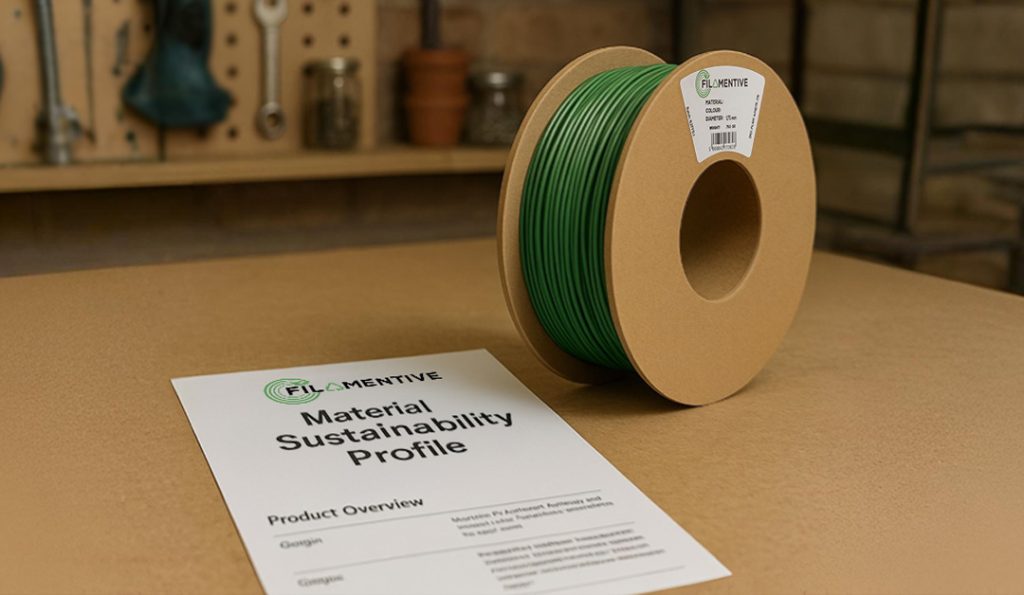
With “eco‑friendly” stickers everywhere, how do you know what’s greenwashing and what’s real? Filamentive addressed this head‑on by launching Material Sustainability Profiles for every filament in their range. Each profile details the product’s origin, recycled content, additives, shipping considerations, certifications and end‑of‑life options. The goal is transparency: whether you’re running a factory or tinkering in a shed, you deserve to know exactly what’s in the material you’re printing with.
Material Sustainability Profiles
Recycled Nylon Filament made from MJF Powder Recycling
Another pioneering project tackled one of 3D printing’s lesser‑known waste streams—unused powder from MJF 3D printing. Estimates suggest that up to 60 % of PA12 powder goes unused after a build, sometimes more than 1 000 kg per year for busy production labs. Filamentive teamed up with 3devo to recycle this powder into new PA12 filament for FDM printers. By September, prototypes were in testing with select customers, with commercial launch planned for early 2026. Recycling this powder can cut carbon emissions by up to 89 % compared to virgin nylon, making it one of the most significant sustainability breakthroughs of the year.
What’s Next for Filamentive and UK 3D Printing Materials?
Looking at sales data from 2025, PLA still dominates the UK market. PETG, Tough PLA and ASA round out most applications, while specialty filaments like Carbon Fibre PETG and Wood PLA are rising fast. XL spools are now mainstream for service bureaus and industrial users, and spool‑less refills are catching on thanks to Bambu Lab’s AMS. Meanwhile, Filamentive is continuing to develop high‑temperature materials like PEEK and Ultem to meet the demands of the aerospace, automotive and medical sectors.
All signs point to an industry that’s maturing quickly. Buyers want materials that perform without compromising the environment. They’re asking tougher questions about sourcing, recyclability and end‑of‑life solutions—and Filamentive is meeting those demands head‑on. As we move into 2026, expect more recycled-content releases, more transparency and more collaborative projects that turn 3D printing waste into opportunity.
Ready to take your printing to the next level? Explore our full range of sustainable filaments, try our spool‑less refills for your Bambu Lab AMS, and join our recycling programme. The future of additive manufacturing is green – and you can be part of it.