
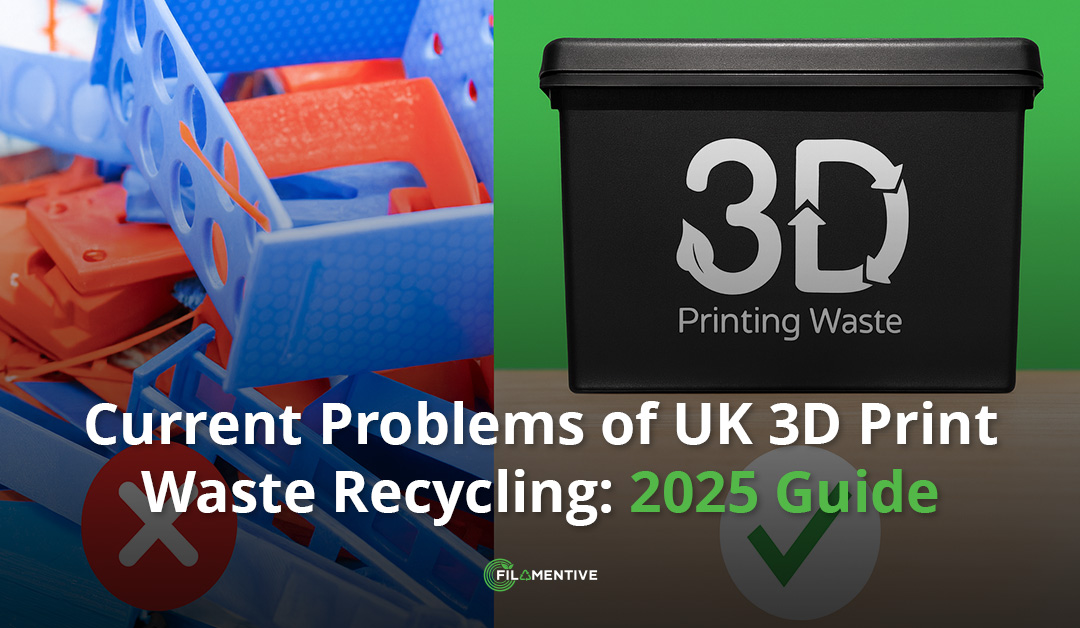
Why 3D Print Waste is a Growing Problem in the UK
As 3D printing adoption grows across education, industry, and makerspaces, so does its environmental footprint. While additive manufacturing is often positioned as a low-waste process, the reality is that failed prints, support material, and prototyping iterations still generate substantial plastic waste.
In the UK, we estimate that filament-based 3D printing creates around 379,000 kg of plastic waste per year, with typical users generating waste rates as high as 33%. Without dedicated recycling systems, much of this ends up in landfill—particularly PLA, which is rarely accepted in kerbside recycling schemes and not compostable at home.
This guide explores why 3D print waste recycling remains a challenge in 2025—and how to move toward practical, circular solutions.
What Are the Current Challenges of Recycling 3D Print Waste?
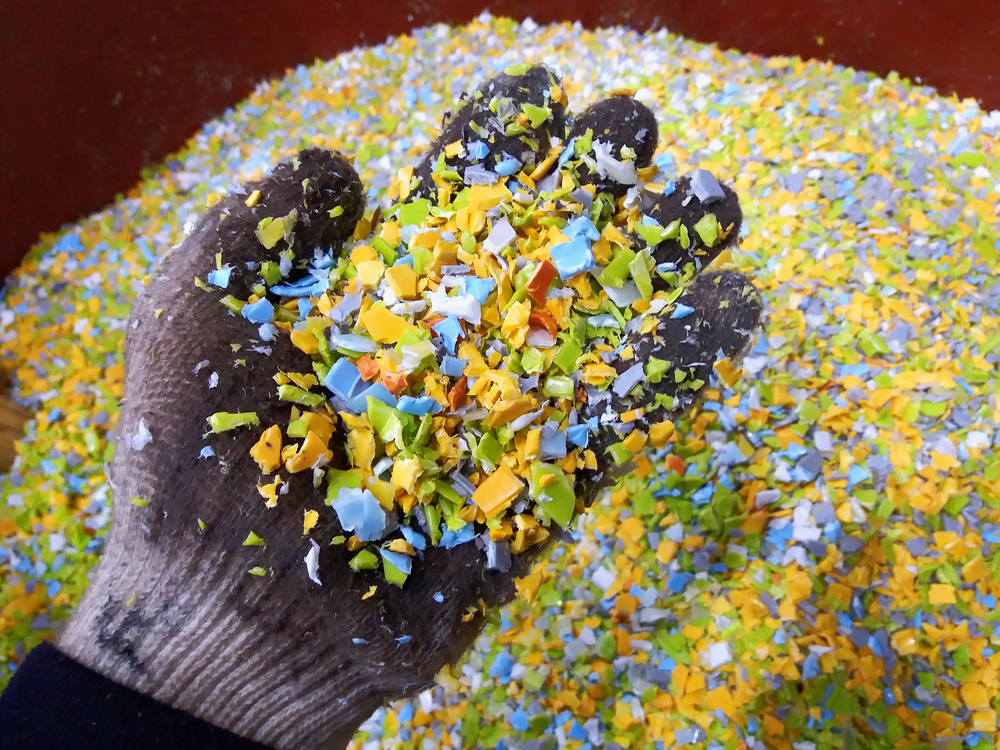
1. Material Sorting & Contamination
Most school labs and mixed-use environments 3D-print in multiple materials—PLA, PETG, ABS, TPU, and more. However, even small cross-contamination can compromise the entire recycling batch. For this reason, most recyclers only accept pre-sorted, single-material waste, such as PLA-only take-back schemes.
2. Quality Loss on Re-melting
DIY recycled filament made from unknown or poorly sorted sources can suffer from inconsistent flow, poor strength, or dimensional instability. Maintaining quality requires either tight process control or virgin material blending—which isn’t practical in low-volume educational or maker settings.
Learn more: A Practical Guide to Recycling 3D Print Waste into Filament.
3. Logistics & Scalability
Recycling is only economically viable at scale. A single workshop may generate only a few hundred grams of waste per month—nowhere near enough to justify individual shipping. That’s why Filamentive’s PLA take-back scheme is paired with customer orders: to consolidate shipments, reduce emissions, and make returns easy and cost-free.
4. The PLA Biodegradability Misconception
Despite being marketed as biodegradable, PLA is not home-compostable and is rarely accepted by UK councils in food or garden waste bins. Without a dedicated PLA collection route, even the most environmentally conscious users may unintentionally send their print waste to landfill.
What’s the Solution? Practical, Cost-Effective Fixes
✅ Design Waste Out From the Start
- Use “supports last” thinking: better orientation, support interfaces, or variable layer heights to minimise excess material.
- Implement quick first-layer calibration tests before running large jobs.
✅ Standardise Materials Where Possible
- Stick to a single, general-purpose material like PLA
- Label bins clearly (e.g., “PLA Only”) and educate staff to avoid mixing
✅ Use Recycled Filament for Everyday Printing
- Filamentive PLA contains 50% recycled content as of July 2025, verified under ISO 14021. It prints like regular PLA, but cuts virgin plastic use in half.
✅ Eliminate Single-Use Spools
- Move core colours (e.g. black, white, grey) to spool-less refills.
- Re-use a durable spool or 100% recyclable cardboard spools to reduce plastic packaging at source.
✅ Join a Simple PLA Take-Back Scheme
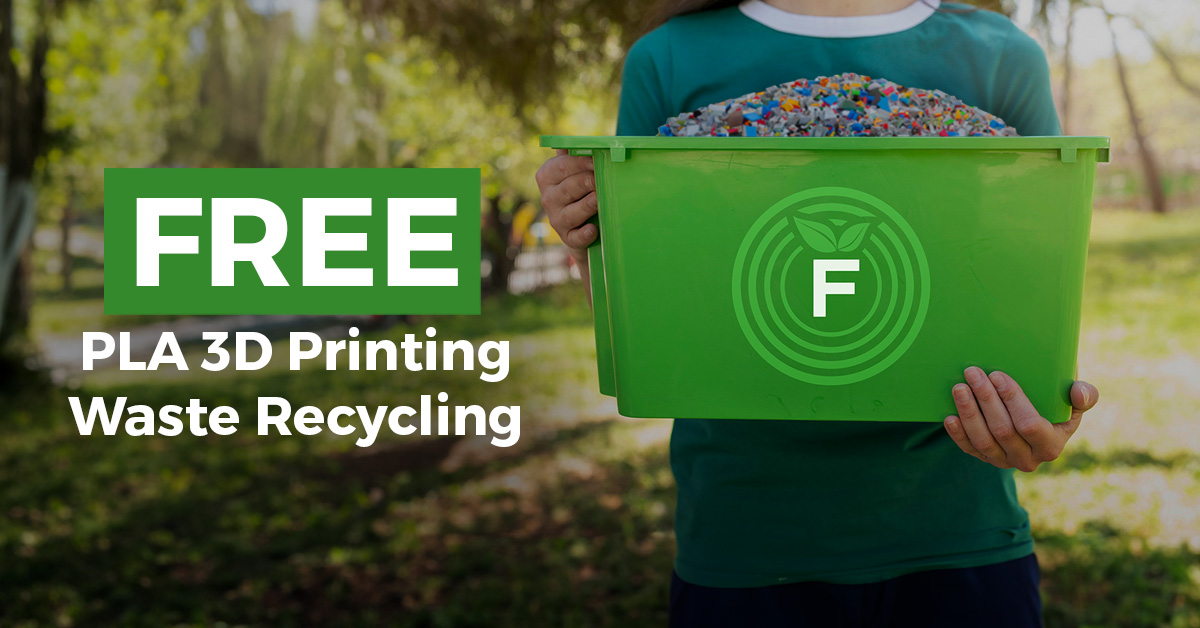
- If you buy PLA from Filamentive, you’re eligible for our free recycling service.
- We send a dedicated box, handle collection, and process the waste through our UK recycling partner, 3D Printing Waste.
- Departments using multiple brands can consolidate waste to fill a single box.
➡️ Learn About Free PLA Recycling
✅ Track 3D Printing Waste to Improve
- “What gets measured, gets managed”
- Calculate your wastage factor based on filament in vs waste generated (kg)
- Track improvements over time or turn into an internal challenge to reduce waste
✅ For Advanced Labs: Close the Loop
- If you run a large printer fleet, explore desktop recycling and filament making (shredders + extruders) to reprocess failed prints in-house.
- These systems can create a near-zero-waste workflow, but require space, budget, and operator training.
Closing Thoughts on 3D Printing Waste Solutions
As 3D printing continues to grow in popularity, it’s time for UK users to move beyond good intentions and into practical, scalable waste solutions. From standardising materials to using recycled filament and joining a free take-back scheme, small changes can have a big impact.
Whether you’re managing a classroom, makerspace, or design lab, Filamentive’s recycling-ready PLA filament and free PLA recycling programme are here to help you print more sustainably—without the added cost.