
Filamentive and 3devo have been named finalists in the Sustainability in Additive Manufacturing category of the 2026 3D Printing Industry Awards, for our work converting waste MJF PA12 powder into recycled nylon filament. Public voting is now open.
The official shortlist describes the project as “3devo and Filamentive’s work on converting polymer powder waste into filament.” The nomination is the news. The waste stream behind it is the more interesting part, because it comes from inside additive manufacturing itself.
What are the 2026 3D Printing Industry Awards?
The awards are run by the publication 3D Printing Industry and recognise companies, people, technologies and applications across additive manufacturing. The 2026 finalists have been announced and voting is open.
Our category, Sustainability in Additive Manufacturing, asks where the industry can make a real environmental difference rather than moving the burden to another stage of production. Material recovery is a good test of that question, because the waste has to go somewhere.
Why have Filamentive and 3devo been shortlisted?
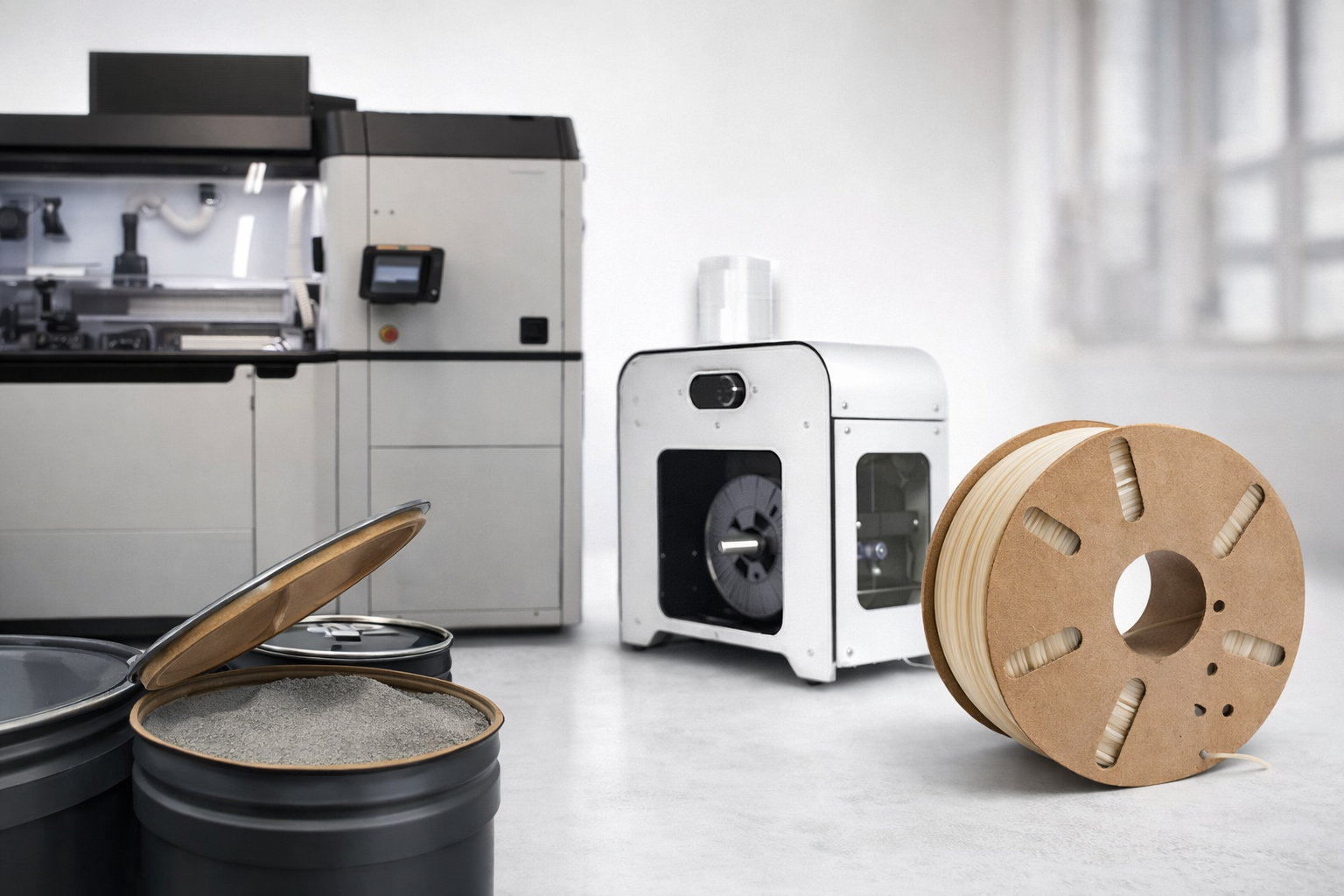
Because the project tackles a waste stream that additive manufacturing creates for itself. Multi Jet Fusion (MJF) commonly uses PA12 nylon powder. Powder can be refreshed and reused within limits, but not indefinitely: it ages, its properties shift, and operators must refresh or replace it to keep part quality consistent. The leftover powder is still a useful engineering thermoplastic that has already been produced, shipped, handled and stored.
3devo and Filamentive developed a route for turning suitable unused MJF PA12 powder waste into filament. The result is Filamentive rPA12.
From MJF powder waste to recycled nylon filament
In principle this is simple. PA12 is a thermoplastic, so powder that is no longer suitable for further MJF builds can be melted and reshaped into filament. In practice, a recycled filament only counts as an engineering material if the feedstock is consistent and the extrusion is controlled.
That is where 3devo, a specialist in extrusion and circular manufacturing, comes in. The project used controlled MJF powder sources to keep the feedstock consistent and the output reliable.
MJF PA12 powder waste (controlled sources) → extrusion → 1.75mm PA12 filament → FFF/FDM printing
We are not saying every degraded, contaminated or fully spent batch of MJF powder can be converted this way. Source control is part of why the process works.
What is Filamentive rPA12?
Filamentive rPA12 is a 1.75mm recycled nylon filament developed with 3devo and made entirely from unused MJF PA12 powder waste. It comes on a 1kg spool in a natural, off-white colour, and slight shade variation between batches is expected because the feedstock is recycled. Recycled content and sourcing details are in the rPA12 Sustainability Profile.
It is positioned as an engineering filament for functional prototypes and end-use parts such as gears, hinges, snap-fits, brackets and housings, and for jigs, fixtures and tooling aids. PA12 suits those jobs because it combines toughness with useful flexibility, wear resistance, lower moisture absorption than Nylon 6 and resistance to oils, greases, fuels and many industrial fluids. It still needs drying before printing.
At launch, Managing Director Ravi Toor described rPA12 as “what we believe to be the world’s first commercially available filament made entirely from recycled MJF powder waste.”
Why does this matter for sustainable additive manufacturing?
Three ideas sit behind the nomination.
The first is keeping an engineering polymer in use. PA12 powder has already absorbed resources and energy before it reaches an MJF production facility. If suitable material gets a second productive life instead of being discarded, more value is taken from polymer that already exists.
The second is reducing reliance on virgin feedstock. Recovered polymer offers an alternative to producing every kilogram of filament from virgin PA12.
The third, and most distinctive, is circularity between additive manufacturing processes. MJF and FFF are usually treated as separate worlds, one industrial and powder-based, the other extrusion-based. Here, the waste output of one becomes the material input of the other. It is not a closed loop, because printed rPA12 parts are not themselves recovered into equivalent new material. It is, though, a practical example of what a more circular materials ecosystem for additive manufacturing could look like.
Vote for Filamentive & 3devo
If you believe additive manufacturing should make better use of the materials already inside the industry, we’d appreciate your support.
Vote in the 2026 3D Printing Industry Awards
To learn more about the material, explore Filamentive rPA12 recycled nylon filament, read how we recycle MJF powder waste or browse our wider recycled 3D printer filament range.